

Safety Behaviours in Emetophobia | What is feeding your phobia
What are Safety Behaviours?
And how they are keeping you feeling anxious
Avoidance | Escape | Checking | Reassurance Seeking | Body Scanning | Hypervigilance | Preventative Behaviours | Worrying | Mental Compulsions

What are safety behaviours?
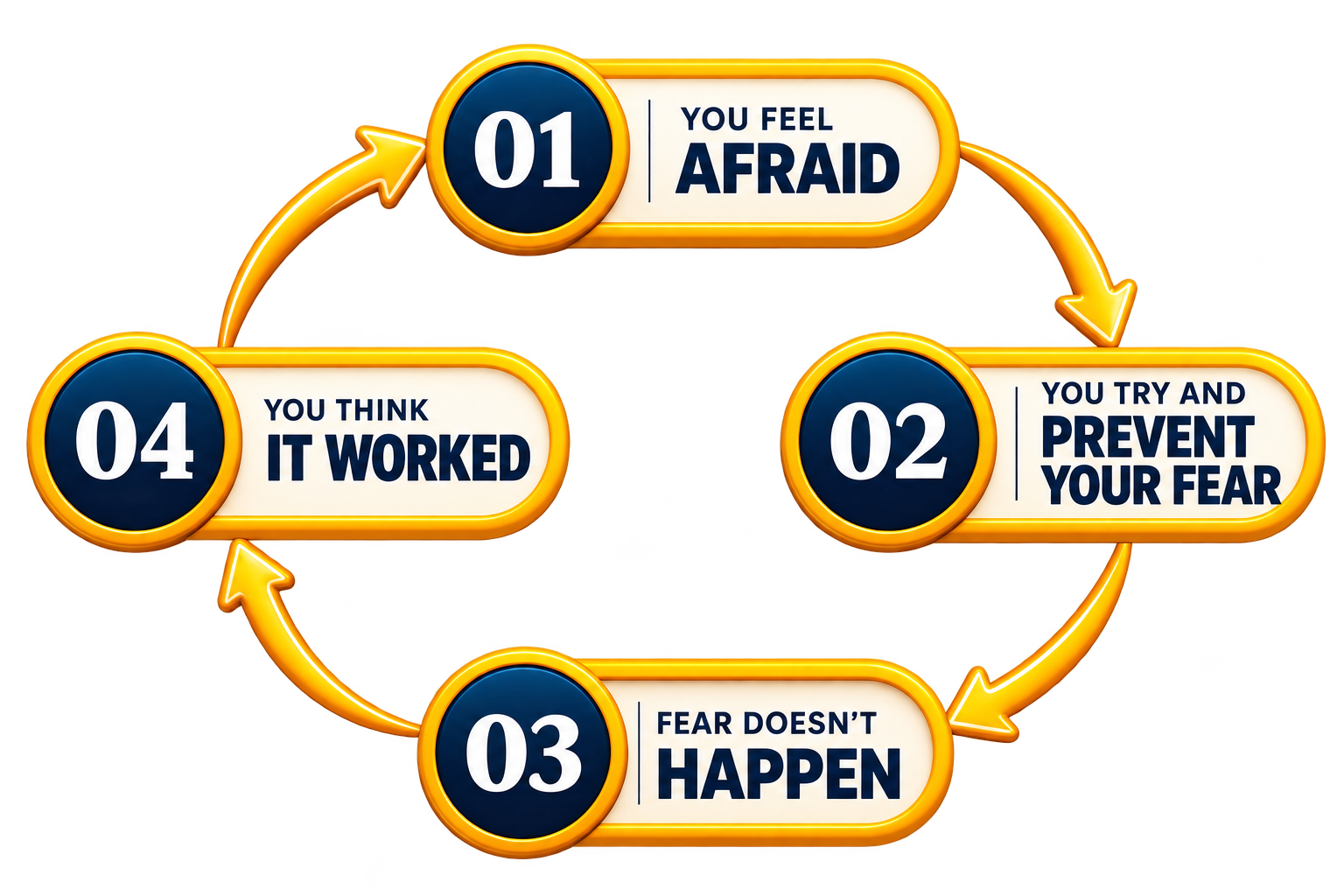
Safety behaviours are any action you may be tempted to use to prevent your fear from happening or to reduce your anxiety. They act like a safety net to prevent your fear. While they seem harmless or even helpful, these behaviours actually feed your Emetophobia. This is because they can convince you that the worst would have happened if you did nothing to prevent your fear.
Let’s demonstrate this using an analogy I like to call “barking at the postman”.
If you already understand this, click here to go to examples of safety-behaviours.

“Barking at the postman” - An analogy of why safety behaviours keep you afraid of sickness
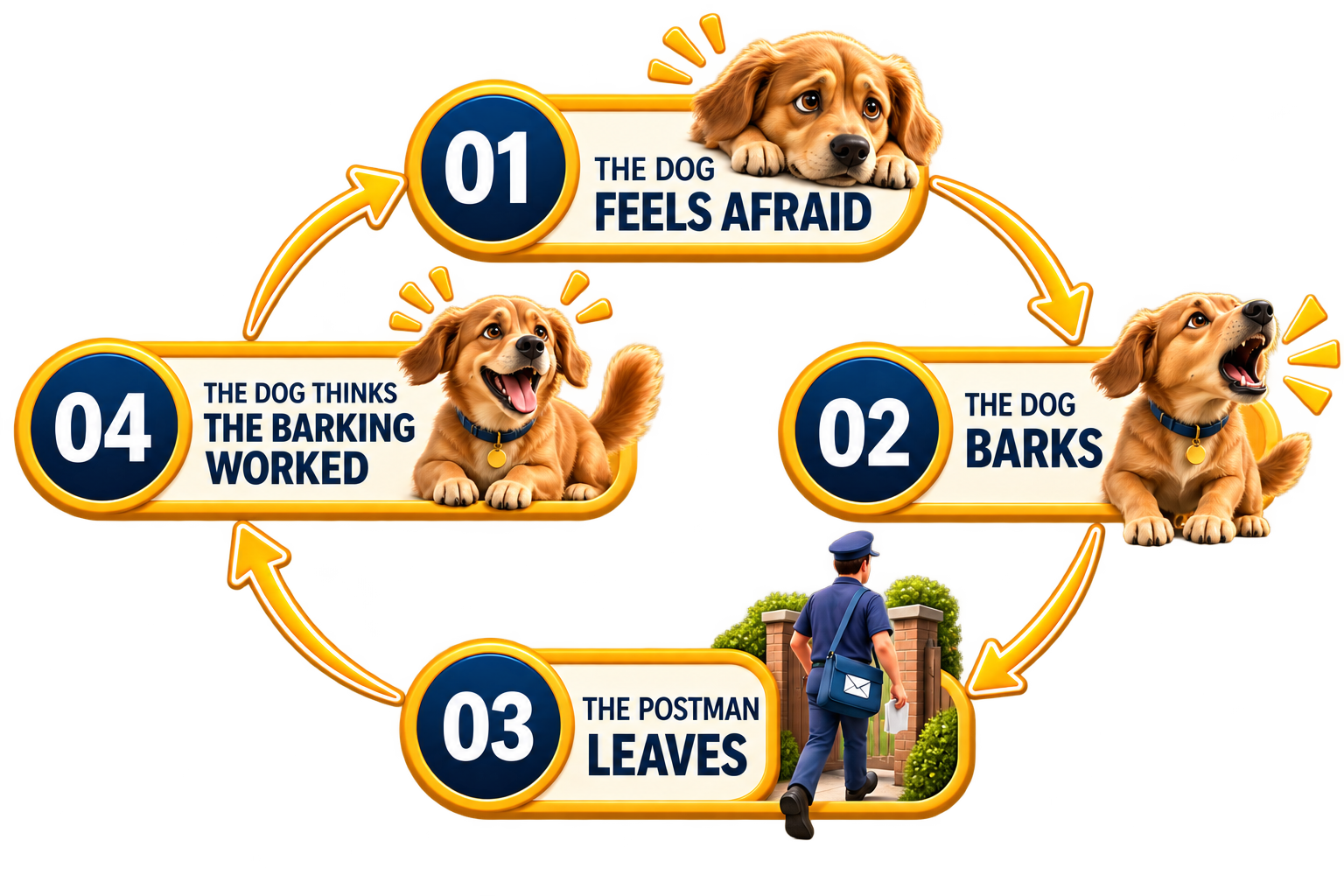
We all know that most dogs bark at the postman. Lets imagine a dog who is scared of the postman. When the postman comes close to the house, the dog perceives a threat. The dog thinks that the postman is going to break in or is a danger in some way.
So the dog barks!
And the postman posts his letter and walks away.
The dog congratulates himself on getting rid of the threat. He learnt that barking keeps the postman away. Good boy!
However, we all know the postman would have walked away on his own. Each time the dog sees the postman he still sees him as a threat and barks. He thinks his barking is working.
Now imagine you could speak with dogs and you ask him to take a “risk” and not bark at the postman for the week.
The dog see’s the postman coming and does not bark. To his surprise the postman posts his letter and walks away… He thinks “maybe I got lucky, I am sure he will break in next time”.
The day next comes, and the next day after that. The dog doesn’t bark and the postman still hasn’t broken in. Soon the dog realises he was wrong and that the postman was not trying to break in.
“Key message:
When we use our safety behaviours we never get to see what would have happened if we did nothing. We are barking at the postman even when he was going to walk away anyway.
So, we need to test out our predictions of what will happen by facing our fear without trying to prevent it.
Safety behaviours only keep you trapped feeling anxious, even when nothing bad happens.
What counts as a safety behaviour?
Almost anything can become a safety behaviour if you use it to prevent your fear from occurring or to reduce your anxiety. It is less about ‘what you do’, and more about ‘why’ you do it.
Safety behaviours usually fall into one or more of these five main categories:
1) The first category is to prevent your fear by not being there or taking the chance of it occurring. This is done in two ways: Avoidance and Escape behaviours.
2) The second category is related to checking if your fear is occurring or going to occur or not. This is also done in two ways: Checking and Reassurance seeking.
3) The third category is to directly try to prevent the feared outcome from occurring or to mitigate how bad it will be.
4) The fourth category is a range of mental behaviours design to deal with uncertainty, anxiety and thoughts.
5) The fifth category is called neutralisation and relates to trying to deal with the impact of negative thoughts.
6) The last category is called “Accommodation”. This is when others start using safety behaviours on your behalf. This can either be because you have asked them to, or out of their kindness to try and reduce your anxiety. Although well-meaning, this feeds your anxiety over time.
Read on, or click a specific section to go to that particular section

-
Avoidance & Escape
-
Checking & Reassurance
-
Preventative Measures
-
Mental Strategies
-
Neutralisation
-
Accommodation
Avoidance and Escape Behaviours:
This type of safety behaviour is easy to understand. It is the act of avoiding or leaving (escaping) situations, people, places, things or anything that triggers you.
Examples of avoidance and escape behaviours for those with Emetophobia:
-Avoiding situations where vomiting might occur.
-Avoiding certain foods or drinks.
-Avoiding public transportation.
-Refusing to eat out at restaurants.
-Avoiding hospitals or medical facilities.
-Avoiding watching TV shows or movies that might depict vomiting.
-Avoiding children or pets.
-Refusing to travel.
-Avoiding certain smells.
-Avoiding becoming pregnant.
-Avoiding certain cooking methods.
-Avoiding attending social gatherings or parties where alcohol is consumed.
-Avoiding visiting amusement parks or going on rides that could cause motion sickness.
-Avoiding participating in sports or physical activities that might lead to nausea.
-Avoiding going to concerts or crowded events where you might feel trapped.
While all of these things can be avoided, many can also be “escaped” from. Escape is the act of leaving a situation or stopping as soon as you become anxious.
-Avoiding using elevators or escalators due to the fear of feeling dizzy.
-Avoiding taking medications that list nausea as a potential side effect.
-Avoiding being around people who are sick or have recently been ill.
-Avoiding eating at buffets or where food hygiene is uncertain.
-Avoiding traveling by airplane due to the fear of air sickness.
-Avoiding going on boats or cruises where motion sickness is a risk.
-Avoiding visiting places with strong or unusual smells.
-Avoiding engaging in activities that involve spinning or rapid movement.
-Avoiding trying new or unfamiliar foods.
-Avoiding attending school or work during flu season.
-Avoiding using public restrooms due to concerns about cleanliness.
-Avoiding being in environments where they cannot easily leave if they feel unwell.
-Avoiding going to the gym or fitness classes where you might overexert themselves.
Why avoidance makes your phobia worse:
Avoiding or escaping reinforces your fear because you rarely get to see what would have happened if you did not avoid. Your brain fills in the gaps with the idea that it would have been awful. So it learns to fear that situation even more.

Checking Behaviours:
This type of safety behaviour involves attempting to confirm whether your fear is happening or is likely to happen. This is typically achieved through in four main ways:
1) Checking.
2) Reassurance-Seeking.
3) Body scanning.
4) Hypervigilance (scanning externally for danger).
Checking Behaviour:
Checking behaviour is any action that you do to monitor or check something to check for signs of danger. Examples include:
-Continuously checking your pulse or heart rate for signs of anxiety.
-Constantly monitoring your diet and avoiding foods that might cause nausea.
-Regularly checking the bathroom for cleanliness before using it.
-Continuously monitoring your body temperature for signs of illness.
-Constantly checking your surroundings for potential triggers of nausea.
-Continuously checking your medication for potential side effects.
-Constantly monitoring your physical activity levels to prevent overexertion and nausea.
Reassurance-seeking:
Reassurance seeking is a type of checking behaviour where instead of checking ourselves, we ask questions to get the opinions of others about the chance of danger. Examples include:
-Constantly asking friends or family if they look pale or unwell.
-Frequently seeking confirmation from others that they are not sick.
-Asking for reassurance if foods are safe to eat.
-Googling the safety of places, situations, foods or activities.
-Asking for reassurance on online forums.
-Repeatedly asking for reassurance that the food you are about to eat is safe.
-Continuously asking others if they feel nauseous or unwell.
-Regularly seeking reassurance that your surroundings are clean and free of germs.
-Frequently asking for confirmation that you do not have a fever or other symptoms.
-Constantly seeking reassurance that you will not get sick in certain situations.
-Continuously seeking reassurance that you will be able to leave a situation if you feel unwell.
-Regularly asking for confirmation that you are not overexerting yourself.
-Frequently seeking reassurance that your medication will not cause nausea.
-Repeatedly seeking reassurance that you will not encounter any triggers of nausea.
-Continuously asking for confirmation that you are not in an environment where you might feel trapped.
-Regularly seeking reassurance that you are not exposed to potential illness triggers.
-Checking expiration dates obsessively.
-Monitoring bodily sensations excessively.
-Excessive internet searching about vomiting.
-Checking for signs of illness in others.
-Checking the cleanliness of food preparation areas.
-Checking food is cooked before each bite.
-Constantly checking for signs of nausea or stomach discomfort.
How checking and reassurance seeking makes your phobia worse:
Checking and reassurance seeking reinforces your fear because you get addicted to the short term reassurance it often provides. It often gives you a quick sense of safety when you get the answer you want but it grows your fear and preoccupation with the thing you are checking or acting about. This leads to more thoughts about sickness and an increase in your long term anxiety.
Body scanning:
Body scanning is when we turn our attention away from the external world and into our bodies. This is to monitor for internal ‘threats’ like nausea, food poisoning or any signs of illness. This normally comes in two forms.
1) When we look for a symptom (body scanning): The first type is what we call “body scanning” where you decide to scan your body to look for physical symptoms that could indicate you will be sick. This is usually done before you even notice a physical symptom. You are looking for one.
2) In response to noticing a symptom (monitoring): While the second type is when you monitor your symptoms after already noticing a physical symptom. This is done when you notice a gastrointestinal symptom, nausea, or other symptom which you see as a potential sign or threat and want to know more about it, monitor it and see if it gets better or worse.
Examples of body scanning can include:
The morning check: You might scan your stomach when you wake up.
The pre-meal scan: You might focus on your stomach before deciding to eat to make sure you don’t feel nauseous, unwell or if something feels "off."
During social occasions: You might check in on your stomach sensations while out in public or at a restaurant.
Swallowing: You might swallow several times to check for "lump in throat" or if you are producing too much saliva.
Gurgling: You might check for gurgling or any signs of discomfort. Some people prod or touch their tummy to achieve this.
Scanning: You might pause for a while and focus on your sensations.
Imagery: You might imagine eating or look at food to check if you feel hungry or not as a way of seeing if you feeling sick or not.
Examples of monitoring can include:
Focusing: You might highly focus on your symptoms and try to analyse them.
Rating: You might try rating your sensations from 0-10 and regularly reviewing to see if it is changing.
Location: Some people try to figure out where their sensations are precisely and if it is moving, growing or getting better.
Comparison: You might try and compare how you feel now and how you felt a few minutes ago or even the last time you were actually sick to see if the sensations match.
Fullness: After eating, you might keep your "spotlight" on how full you feel.
Clock watching: You might monitor the time when a sensation starts and how long it has lasted.
Hypervigilance (scanning externally for danger):
Hypervigilance is when we turn our attention onto the external world and scan for dangers. This is to monitor for external “threats” such as ill people, mould on food, contamination or anything that could lead to us being sick. More examples include:
Social
It is possible to become hypersensitive or scan for signs that others might be contagious or about to be sick.
Complexions: Constantly checking if someone pale or sweaty.
Behaviours: Noticing if someone is acting strangely or doing anything that might indicate they are sick.
Sounds: You might be on high alert for any sounds in public toilets, restaurants, pubs for other locations.
Food:
You might become hypervigilant around food safety.
Food texture & colour: You might be highly sensitive and monitoring textures, colours, smells or sounds foods make.
Sale by dates: You might check the "sell-by" date on every item in the fridge.
Food preparation: You might watch how others handle food or cook foods, or if the area is clean.
Cross-Contamination: You might not be able to take your eyes of something you consider contaminated such as watching someone who has just used a knife that touched raw meat.
Ingredients: You might be hypervigilant for ingredients in foods you think might lead to sickness, especially if you have any food allergens or intolerances.
The environment:
You might act hypervigilant in situations to ensure safety.
Exits and toilets: You might immediately locate the nearest exit or bathroom upon entering a new room or watch it in case others rush to use it.
Scanning for people: You might scan for children or people who appear ill or those you perceive as higher-risk carriers of germs.
Contamination
You might scanning for "invisible" threats on surfaces.
Surfaces: You might scan for which surfaces others have touched (door handles, handrails, elevator buttons).
Cleanliness: You might scan for stains, wet patches, sick, or the general levels of cleanliness.
Hygiene: You might scan for the hygiene levels of other people such as handwashing, sneezing or other indicators of un/cleanliness.
How scanning for danger makes your phobia worse:
Scanning for danger, either externally or inside your body massively feeds emetophobia. Both actions raise anxiety because you are anticipating a danger. When body scanning, this anxiety then causes nausea. Which is often the thing you were scanning for in the first place. This validates that you are at risk of being sick when in reality this nausea is just a side effect of anxiety and not linked to being sick at all. When scanning for danger externally, your anxiety also raises because you are predicting the worst. This also causes nausea, but also causes you to notice a lot of ‘false alarms’. These false alarms are things that look like a threat such as someone coughing or looking unwell but are not likely to make you sick. When using these safety behaviours, your external and internal world start seeming unsafe. Often prompting you to avoid or use other safety behaviours to manging this heightened sense of risk.

Preventative Behaviours:
This type of safety behaviour involves attempting to prevent nausea, gaging, dizziness, anxiety, becoming ill, the act of vomiting or any other fear you have. Often these behaviours often overlap with the other categories previously mentioned as all safety behaviours are a way to try and prevent your fears. However, see this category as things you directly do to try and prevent sickness.
Examples of safety behaviours designed to prevent your fear occurring:
-Only eating “safe” foods.
-Only eating small, frequent meals to prevent an upset stomach.
-Drinking ginger tea or taking ginger supplements to soothe nausea.
-Using anti-nausea medication regularly.
-Keeping a glass of water nearby to sip on.
-Chewing gum or sucking on mints to alleviate nausea.
-Practising deep breathing exercises to calm anxiety.
-Using hand sanitiser frequently to prevent illness.
-Excessive cleaning or desensitising.
-Taking motion sickness medication before travelling.
-Using essential oils or scented products to counteract unpleasant smells.
-Using a stress ball or fidget toy to manage nervous energy.
-Using air fresheners to overcome any unpleasant smells linked to nausea.
-Keeping medication readily available “just in case”.
This list could go on forever and everyone has different methods they try to use.
How preventative safety behaviours make your phobia worse:
Being sick is very rare. Most people are only sick once every few years or more on average (when you take out self-inflicted reasons such as a excessive alcohol use) but for those with emetophobic it feels like a daily threat due to the nausea they often feel. This nausea is a side effect of your anxiety and disgust response and not about being sick. When someone uses preventative measures, they trick themselves into believing that their behaviour stopped themselves being sick. Every episode of nausea feels like a near miss that was only prevented by their safety behaviour. These behaviours stop you from realising that you are rarely going to be sick. And with each ‘near miss’ you train yourself to be more and more scared.
Mental safety behaviours:
Many safety behaviours are internal and not visible to others and relate to the way in which someone with Emetophobia thinks.
These are:
Worrying.
Overthinking (Rumination).
Distraction.
Mental planning.
Positive affirmations.
Each one is trying to achieve a different way of coping with your Emetophobia. However, each one backfires in the long term to only make your phobia worse.
Worrying:
Worrying is the attempt to answer ‘what if’ questions. Those with Emetophobia often spend a long time in their head worrying about the future, upcoming plans, sensations, foods, safety behaviours, others, sickness, nausea, or panic attacks. Worrying is an attempt to reduce the uncertainty about the future, but backfires by causing less certainty, more anxious thoughts, nausea, anxiety or intrusive imagery.
Rumination:
Overthinking (rumination) is the attempt to answer ‘why’ questions. Those with emetophobia often spend excessive amounts of times trying to figure out what is causing their symptoms of nausea or other symptoms, what caused their previous episodes of sickness or going over problems in their mind excessively.
Distraction:
Distraction is the attempt to not think about certain thoughts at all. Sometimes those with anxiety try to stay really busy so they don’t have time to worry or think about sickness. This only sends the message that ‘sickness too scary to even think about’. Distraction never lasts in the long term as it is exhausting and can not be done forever. Often night-time is hard for those who try to distract themselves during the day because they are now suck with all those thoughts and worries with nothing left to distract them.
Mental Planning:
Mental planning is when you get stuck in your head overthinking ways to overcome problems. It is when you are in your head trying to plan for all the things you think are about to go wrong. You may focus on where toilets and exits are or how you will react if someone else or yourself is sick. This only raises your anxiety as you are always assuming the worst could happen at any time.
Positive affirmations:
Positive affirmations function as a form of denial in which you are trying to force positivity or thoughts that you will not be sick. These may seem helpful on the surface, but they rarely work and only make you feel worse because they don’t feel believable.
How mental safety behaviours make your phobia worse:
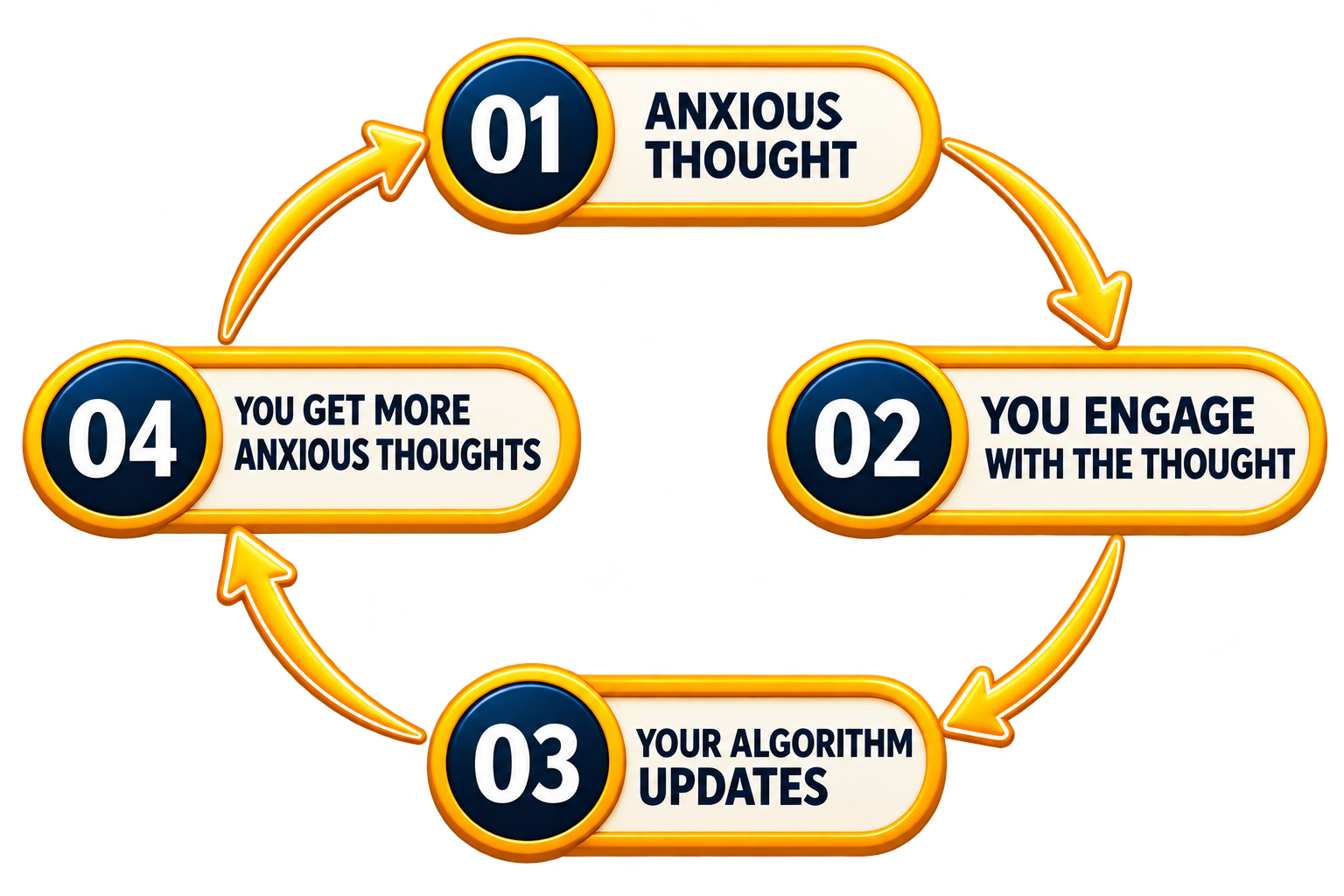
There are many reasons mental safety behaviours make your phobia worse. However, the main one is that they train your mind to become pre-occupied with sickness and massively increase the amount of anxious thoughts you have. The reason is occurs is because your mind works similar to a social media algorithm. On social media content the authors always ask you to watch, like, comment and subscribe to their content because it changes your algorithm to show you more of their content. Imagine if you liked every cat video for the next week, your YouTube is going to show you more videos of cats. Your mind is the same. It doesn’t care what content you like or want. It shows you things it thinks is relevant based on how you interact with it. When you use these mental safety behaviours, you are training your mind to produce more and more anxious thoughts, not less.

Neutralisation
Many people with Emetophobia are distressed by having thoughts or images about being sick. This often due to one of these three reasons:
1) These thoughts cause anxiety, and anxiety can cause nausea. This nausea then validates their fear might happen.
2) These thoughts can activate the disgust response, which produces nausea. This nausea then validates their fear might happen.
3) Sometimes people believe that having these thoughts or images makes it more likely that their fears will occur.
When people believe the third reason, it makes their mind a scary place. Certain thoughts become off limits and you may try to really push them away or prevent them. When these thoughts slip through, and they always slip through, they try to “undo” the thought to “neutralise” the damage. Neutralisation is the voluntary act of trying to distract, eliminate, prevent, or fix the perceived consequence of having an obsessional thought or the discomfort associated with having the thought. This is common for those who also have OCD alongside their emetophobia.
Examples of Neutralisation
-Distraction.
-Thought suppression (pushing away a certain thought).
-Substituting one thought or image with another one in your mind.
-Keeping busy to avoid thoughts.
-Repeatedly counting in your head.
-Self reassurance.
-Positive affirmations.
-Repeating phrases.
-Compulsively praying.
-Over analysing thoughts or feelings.
-Mentally reviewing actions or situations.
How neutralisation make your phobia worse:
When you react to a thought by giving it too much of our attention, trying to prevent it, supress it, or undo the impact the thought might have, you are taking the thought very seriously rather than realising that it is just a a bunch of words or pictures in your mind. People have random intrusive thoughts all of the time but dismiss them as nothing of important. As if it is just a strange thought. They give it zero attention. However, when have an intrusive thought about something relevant or scary for us personally, we struggle to dismiss it as meaningless. We give the thought too much power. Each time you try to neutralise a thought, you train your brain that these particular thoughts are important, so your mind produces more of them, even though you find them scary.

Accommodation Safety Behaviours:
Accommodation is when family members or friends try to help reduce your anxiety by participating in your safety behaviours or change their behaviour to try to not trigger you.
This might include providing reassurance, avoiding telling you certain information, hiding triggers, helping you check for signs of danger, or assisting you in avoiding situations you fear. Although these actions are done with good intentions, they always unintentionally strengthen your anxiety and make recovery more difficult.
Examples of accommodation safety behaviours friends and family might offer you
Offering reassurance:
“You’re not going to be sick.”
“Nobody else has been sick.”
“The food is definitely fresh.”
“That person doesn’t have a stomach bug.”
“You’ll be fine.”
Repeatedly answering your “Are you sure?” questions.
Checking symptoms or situations for you.
Googling symptoms, illnesses or contamination risks for you.
Reassuring you that a sensation is “just anxiety.”
Helping you avoid triggers
Agreeing not to go to places where someone might vomit.
Avoiding restaurants, pubs, parties or crowded events.
Not travelling by plane, coach, train or boat.
Changing holiday destinations because you are worried about illness.
Leaving an event with you if you become anxious.
Avoiding particular foods or restaurants.
Not eating food that you consider “risky.”
Avoiding certain activities because you are worried about vomiting.
Helping with compulsive behaviours
Washing your hands for you or helping you clean.
Cleaning surfaces repeatedly to make you feel safe.
Throwing away food because you are worried it could cause vomiting.
Replacing food or drinks that you become concerned about.
Allowing excessive showering, handwashing or changing clothes.
Providing bags, tissues, medication or cleaning products “just in case.”
Checking bins, toilets or vomit-related material before you enter an area.
Monitoring for signs of illness
Checking whether other people look unwell for you.
Asking someone if they feel sick before you enter a situation.
Watching other people's behaviour for signs they might vomit.
Checking the toilet or bathroom after someone has used it.
Monitoring family members for signs of a stomach bug.
Checking the dates, smells or appearance of food for you.
Checking whether food has been cooked properly for you.
Taking responsibility for your escape
Sitting next to you so you can leave quickly.
Driving you home whenever you feel anxious.
Agreeing on an “escape plan” for every situation.
Staying awake with you because you are worried someone might vomit during the night.
Sleeping in the same room to reassure you.
Being available by phone whenever you are away from home.
Going with you to appointments, social events or journeys that you would otherwise avoid.
Changing family routines
Eating separately.
Preparing completely different meals.
Keeping certain foods out of the house.
Avoiding discussing illness or vomiting.
Avoiding films, TV programmes or conversations containing vomiting.
Changing sleeping arrangements when someone is unwell.
Keeping siblings or children away from someone with a minor illness.
Cancelling plans whenever someone in the family feels slightly unwell.
Often accommodation is less obvious to spot because it looks incredibly caring.
How accommodation make your phobia worse:
It is only natural for friends and family members to start using these behaviours even if you have never asked them too. People naturally try and help and support each other. However, these behaviours often reduce your own confidence at handling the world independently. Often your world gets smaller and starts to feel like a white padded room.

Safety behaviours need to be stopped to overcome your emetophobia. You can not recover while you continue to do them.
“How do I break free from these safety-behaviours?”
Visit my free self-help page to get started.
Therapy from someone who truly understands emetophobia
Finding a therapist who understands emetophobia can be surprising difficult.
I’m David Kaneria, a BABCP accredited CBT therapist who specialises exclusively in treating emetophobia.
I’ve dedicated my career to learning about this condition, treating people with emetophobia and helping other therapist understand how to treat it effectively.
I’ve also written a textbook specifically about treating emetophobia.
David Kaneria
BABCP Accredited CBT therapist & Emetophobia specialist.