

Specialist CBT Therapy for Emetophobia for Teenagers | Help for Your Child’s Fear of Vomiting
Is your child’s fear of vomiting taking over their life?
Specialist CBT therapy to help teenagers overcome emetophobia, build confidence and get back to school, friendships, food and everyday life.
Specialist online therapy for children aged 12+


No obligation | Confidential | Specialist Emetophobia Therapist

What is Emetophobia?
No one likes being sick. Its only natural to want to avoid it. But what do you do if you are a parent with a child who really really really doesn’t want to throw up to the extent it is impacting on their life, school, friendships and mental health.
The extreme fear of vomiting is known as Emetophobia and effects up to 7-9% of people. This makes it one of the most common phobia’s in both adults and children. Yet sadly, awareness of this disorder is often lacking in both schools and even from many therapists. Emetophobia is a truly disabling condition that starts to effects every area of your child’s life. Unfortunately, Emetophobia rarely gets better on its own and children don’t just grow out of it. Luckily, treatment is highly effective.
How do I know if my child has Emetophobia?
For those without Emetophobia, it is normal to be nervous about being sick when ill, but for children with Emetophobia, their fear of being sick is way stronger and they can start to become afraid even when they are not ill. Their thoughts can become pre-occupied with the chance of catching a tummy bug, food poisoning or seeing others be sick.
If your child has Emetophobia they will often go to great lengths to avoid places, foods, activities or things they associate with being sick. They might also repeatedly ask questions and seek reassurance from you about the chance of them being ill.
Emetophobia can develop early, around the age of 9 and is more commonly diagnosed in girls. Often Emetophobia can develop following an episode of vomiting or seeing others be sick. However, for some children no recognisable event occurs.

Signs and Symptoms of Emetophobia in Children
Anxiety symptoms:
Emetophobia is a type of anxiety disorder. This means your child will experience the physical symptoms of anxiety when they have thoughts about being sick, feel nauseous, picture being sick or come into contact with something they believe will lead them to be sick. These symptoms can include:
Uncontrollable worrying.
Nausea.
Rapid heart rate (palpitations).
Faster breathing.
Panic attacks.
Poor sleep.
Reduced eating.
Avoidance behaviours:
Anxiety is designed to keep us safe and acts like a warning sign of danger. One of the ways it attempts to keep us safe is by wanting us to escape or avoid dangers. This makes sense for real threats. However, for those with emetophobia, their anxiety system has incorrectly identified vomiting as a danger. and applies the same logic of having to avoid it. You might see your child:
Avoiding certain situations were they could see others be sick (school, playgrounds, friends houses).
Refusing to eat certain foods they see as ‘unsafe’.
Keeping away from people who are ill or have been sick recently. This can make going to school a stressful experience if there is a sickness bug going around.
Refusing medications that might cause nausea.
Safety behaviours:
As already mentioned, anxiety is designed to keep us safe and acts like a warning sign of danger. A big part of this is about preventing danger from happening or being ready for it. This often leads to your child doing repeated behaviour’s designed to prevent sickness. These are called ‘safety behaviours'‘ and they seem logical at face value. However, they are symptoms of Emetophobia which only grow and intensify your child’s fear over time.
These behaviours can include:
Excessive checking behaviour: Such as checking dates, mentally reviewing who they spoken to or what they have eaten that day, looking for signs of undercooked foods or ill people.
Reassurance seeking: Your child may start asking repetitive questions about foods, people or if they are going to be sick.
Body scanning: Your child may start monitoring their body for symptoms. This is often not a visible behaviour from the outside but you may see it’s effects. Typically children doing this experience nausea and tummy problems more frequently, if not daily.
Hypervigilance(scanning for danger): Your child may start to become jumpy and become watchful of what they see as dangers. You might see them looking around for toilets, watching you cook, or looking for people who look unwell.
Preventative behaviours: Your child may start to do things to prevent them from being sick such as taking mints, chewing gum or asking for anti-sickness medication.
Worrying: Your child may start to excessively worry for large portions of the day.
Unnecessary planning: Your child may start planning for sickness. They might have to know where the toilets are in restaurants or on trips. They might start carrying around items just in case they are sick.
Distraction: Some children try to keep busy and stay distracted to stop themselves thinking about sickness.

Do children grow out of Emetophobia?
It is unlikely your child will grow out of their Emetophobia. This is because anxiety disorders are self-reinforcing, which means the symptoms of the disorder only grow the phobia over time. It is possible your child may have periods of their life where their phobia appears to disappear, but it often lies dormant until they next get triggered. For example, some children feel better in summer when it is not tummy bug season, but relapse in winter. Without treatment, Emetophobia typically gets worse over time. It is not uncommon to see adults who have had it their entire life since childhood.

Is Emetophobia treatable?
Yes. Emetophobia is highly treatable.
Your child may have lived with it for years and even tried countless ways to control or fix their anxiety, but that doesn't mean they are stuck with it forever. Therapy can give them and you a structured way of understanding what is keeping their fear going and then work step by step to change their fear.
It often requires a therapist with specialist knowledge in the area. It is advised to speak to a therapist like myself who specialises in this phobia compared to a generic therapist. If you can not find a specialist, it is recommended to at least find a BABCP accredited CBT therapist. Do not just trust a therapist you found online who says they ‘do CBT’ without accreditation.
How Do You Treat Emetophobia in Children?
The therapy that has been proven to be highly effective for the treatment of emetophobia right now is Cognitive Behavioural Therapy (CBT for short). CBT is a type of therapy which states that the thoughts that go through our mind are really important because they influence how we feel and how we act. Often our thoughts feelings and actions can create a vicious cycle which only grows our phobia over time.
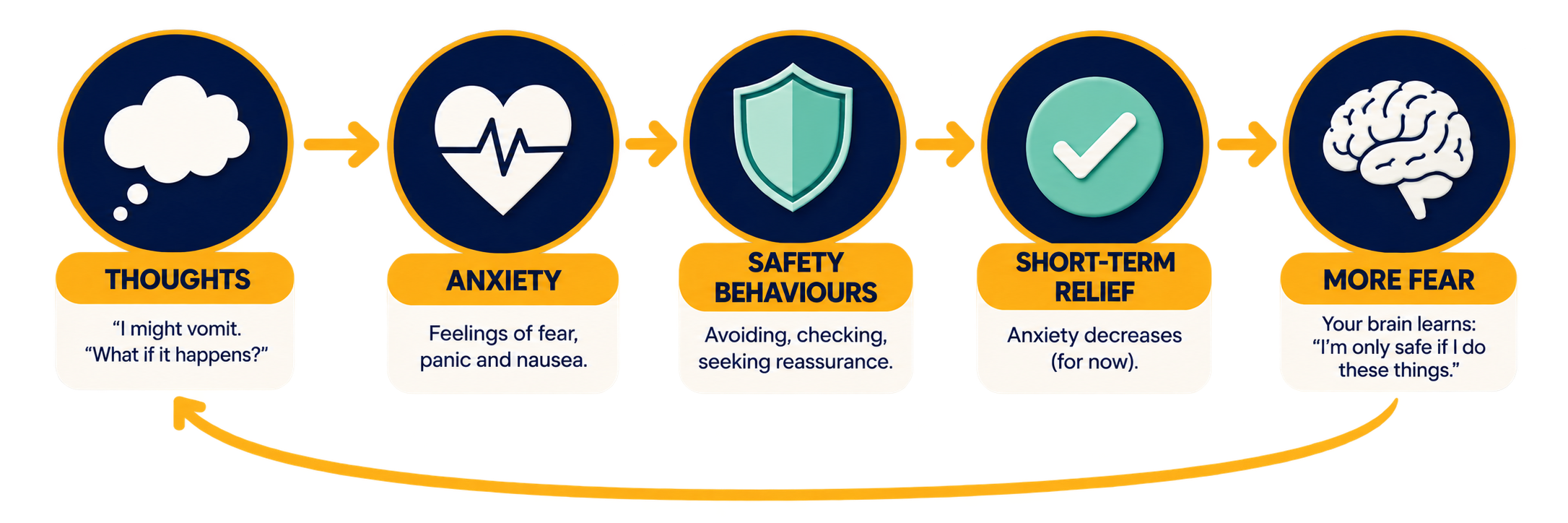
Everyone with emetophobia will have similar but different vicious cycles specific to them. Therapy is about helping your child recognise their own cycles. Once these have been found, specific therapy tools can be selected and tailored towards your child and it becomes much easier for your child to break out of them and to overcome their fear. This type of therapy is designed to be effective and often recovery is possible within 10-20 sessions.

Emetophobia UK is currently full
Due to high demand, Emetophobia UK is fully booked for new clients, and our waitlist is now also full.
We are currently in the process of expanding to meet this high demand. Please check back in at a later date once referrals re-open.
In the meantime, we have a wide selection of free materials to help you get started towards recovery.



What can therapy do for your child
Therapy isn't just about making your child feel less anxious. Yes that is a big part, but it is also about helping them stop organising their life around their fear of vomiting. Therapy aims to give them their life back.
The real goal is to spend less time managing their emetophobia and and instead spend that time living their life.
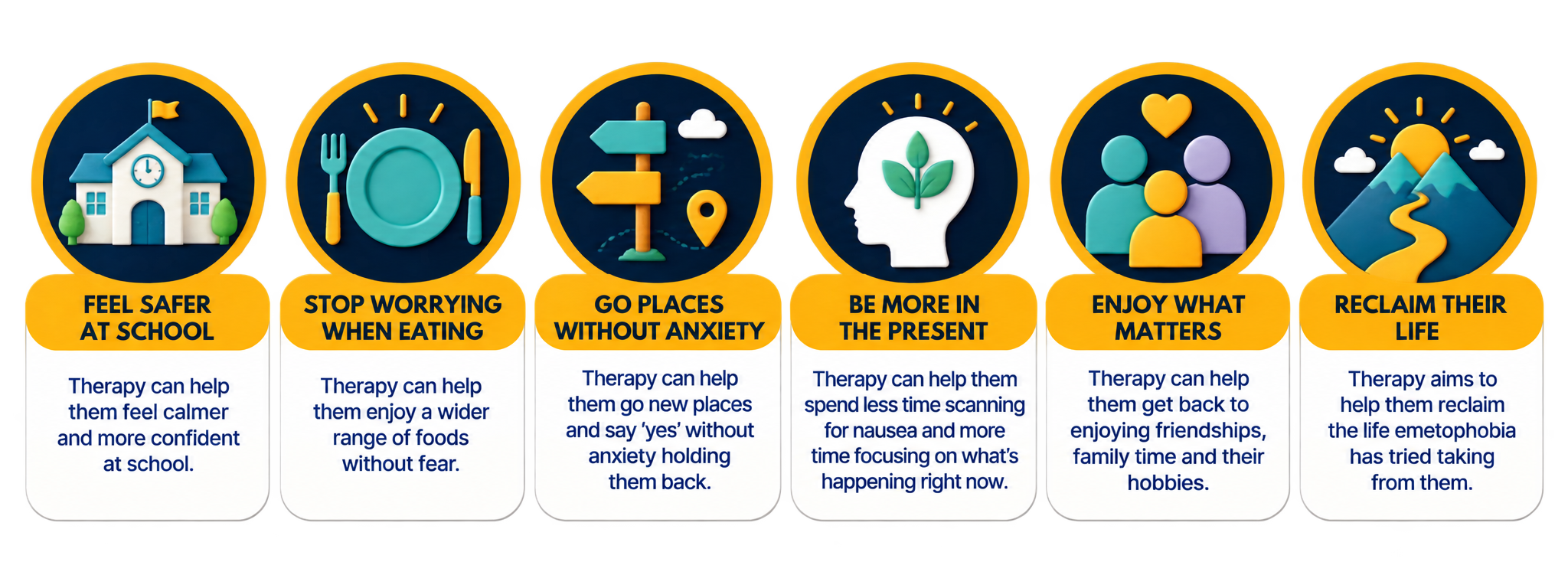
Therapy can help them feel safer at school, stop them worrying when eating, allow them to go places without anxiety holding them back. It can help them be more in the present rather than constantly scanning for nausea. This way they can get back to enjoying friendships, family time and their hobbies. Therapy aims to help them reclaim the life emetophobia has tried taking from them.

A step-by-step approach
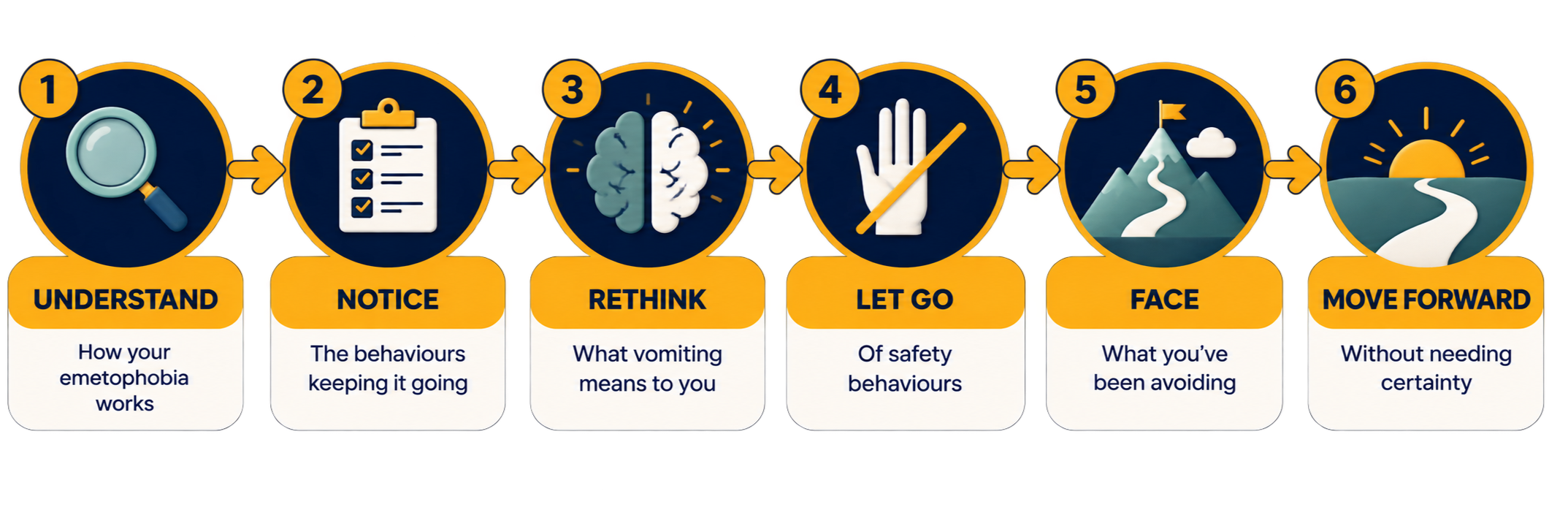
CBT is not about positive thinking or forcing your child to stop being afraid of vomiting overnight. Instead, it works by helping them understand what is keeping their emetophobia going and then making changers were it matters the most.
They will learn to respond differently to their thoughts, feelings and uncertainty, to reduce any behaviours that keep their fear alive, and gradually face the things they have been avoiding to build up their confidence and reclaim their life.
The aim isn’t to give them complete certainty that they will never be sick. It’s to help them feel confident that they can cope regardless of whatever happens.
How CBT breaks them out of their cycle of fear: Their roadmap to recovery.
Why choose David as a therapist?
One of the biggest complains that those with Emetophobia have is that when they have tried to reach out for support in the past, they find that their struggles are not fully understood, their experiences are not validated, and that the standard treatments often fall short of what they needed. Sadly this is all to common. Many therapist don’t know how to treat Emetophobia.
However, I have spent my career trying to change this. Emetophobia is something I specialise in. I have written a textbook and run training sessions for therapists on how to successfully treat it.
If you decide to speak to me, your child will get someone who really understands what they are going through. They will feel heard and understood. Together we will go through treatment as a team to get them better. Recovery is possible.
I aim to make therapy feel engaging, easy, fun and active. This way your child won’t feel like therapy is a scary, difficult or stressful experience.


David Kaneria - Emetophobia Specialist
Accredited Member of the British Association for Behavioural and Cognitive Psychotherapies (BABCP).
University degree - Postgraduate (PG Cert) in High Intensity CBT.
University degree - Postgraduate (PG Cert) in Low Intensity CBT.
University degree - Master of Science (MSc) in Cognitive and Clinical Neuroscience.
University degree - Bachelor of Science (BSc Hons) in Abnormal and Clinical Psychology.
Years of experience as a therapist within the NHS and the medicolegal sector.
Written 9 mental health books, including a textbook on how to treat Emetophobia.

Will therapy be scary? - No
Many people with Emetophobia are scared of therapy as they have heard horror stories of therapists using exposure therapy that was too intense. Sadly that does happen. Many therapists who are inexperienced with treating Emetophobia can try to treat it like another phobia and often can make things worse.
Therapy with myself aims to use as little exposure therapy as possible and focus on other proven ways to overcome your child’s phobia. However, your child will be guided to occasionally put themselves outside of their comfort zone and try new things. When exposure therapy is needed, this will always be done slowly, at your child’s pace and without any pressure.

Let’s do this together.
Why not book in a free no obligation consultation to see if I am the right therapist for your child.
Please note: Due to high demand my therapy private is currently full, but you can join my confidential waitlist for future availability.

Specialist online therapy for children aged 12+ | No obligation | Confidential | Specialist Emetophobia Therapist
To stay in the loop, please follow me on the social media of your choice.

Social story for children with emetophobia
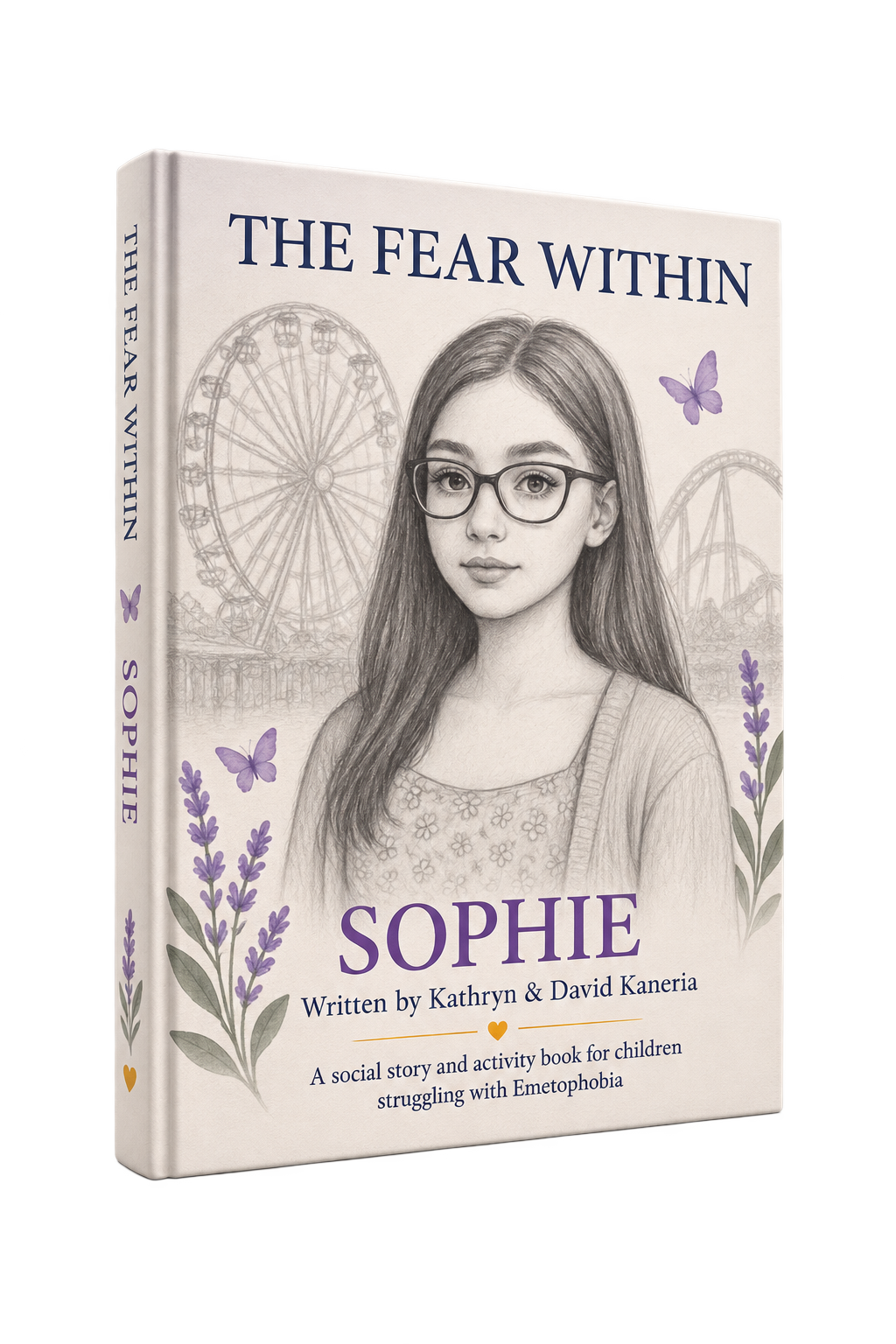
Children with emetophobia can find it hard to go to school or try new things. This book brings these fears to life with the story of Sophie, a girl scared of going on a school tip. The book contains advice, tips and a guide to overcoming your fears. All written to be understood for children aged 8+
What is a social story?
A social story is a book that is designed to echo what your child is going through and aims to help them learn about their own phobia by reading about someone else struggling with their emetophobia.
The book can be found on amazon → Click here