

What causes Emetophobia?
What is Emetophobia (fear of vomiting)
Emetophobia is a common phobia and is the fear of vomiting and feeling nauseous. This fear can be about yourself being sick, someone else being sick, or not being able to cope if it happened.
Living with Emetophobia and the overwhelming fear it causes can feel tough, isolating and often lead to exhaustion and hopelessness about ever getting better. If you find yourself constantly checking food expiry dates, avoiding public transport, or scanning every room for the nearest exit, you are not alone. Emetophobia is a specific phobia that affects up to 5-9% of people, yet it is often misunderstood and rarely talked about.
Whether you have struggled with this fear since childhood or it has developed more recently, often people desperately want to understand the "why" behind their anxiety. This post explores the common contributing factors and, more importantly, how you can begin recovery even without knowing what caused your Emetophobia in the first place [More about treatment for Emetophobia].
What causes Emetophobia
Emetophobia is the intense, irrational fear of vomiting, seeing others vomit, or feeling nauseous. Often there isn’t one single cause, usually, it’s a mix of factors.
Common causes and contributing factors
Genetics, temperament and anxiety sensitivity
While there isn't a specific "Emetophobia gene," some people are born with a more sensitive "threat detection" system. This can be seen in studies looking at identical twins. These studies show that if one twin has anxiety, their twin is more likely to share this trait. This effect still occurs even if the twins were separated at birth which indicates that this is independent of upbringing. However, these studies do not show a 100% chance, so it is possible to share the exact same genes but not share the traits of anxiety. Which shows that environment, life experiences and upbringings is also important in developing anxiety.
Direct experiences
For many, Emetophobia is rooted in a specific distressing event. This might include a particularly traumatic episode of food poisoning, a difficult medical procedure, or an instance of vomiting in public that led to feelings of shame or bullying. In these cases, the brain "tags" the experience and being sick as a significant threat to be avoided at all costs.
Indirect experiences
It is possible to learn to fear being sick by watching others go through a bad episode of vomiting. This might include seeing a school mate, friends or family throw up or exposure to distressing images online or on the TV.
Observing others
We also learn through observing other people. If you grew up with a caregiver, friend or family member who was anxious when someone was unwell, you may have observed that response and learnt indirectly that vomiting is dangerous. Media exposure or hearing frightening stories about illness during childhood can also contribute to the development of the phobia.
Being told negative information about vomiting
Sometimes, the phobia is fuelled by misinformation or "horror stories" about norovirus or stomach bugs. Often people use strong language such as “it lasted forever” or “it was never ending”. When young people hear these messages, they can be taken literally, and they learn to fear vomiting. Being in online Emetophobia support groups can also reinforce this message as all you hear about is how scary vomiting is.
Negative reinforcement (how it gets maintained)
We can also develop a fear because a "bad thing" didn't happen. It sounds a bit counterintuitive at first, but it is a very common way that anxiety works.
Let’s look at an example related to Emetophobia:
Imagine you decide to avoid a friend's birthday dinner because you are worried that the restaurant food will make you unwell. You stay at home and eat a "safe" meal, and so, unsurprisingly, you aren't sick. However, the reality was that the restaurant had excellent hygiene standards and that you were never going to be ill regardless of where you ate.
Your brain doesn't interpret it that way. Because you visualised getting food poisoning, your mind assumes that your avoidance is the only reason you stayed safe. Therefore, the next time someone suggests eating out, your anxiety flags it as another threat. You have "learnt" to be afraid of a danger that wasn't actually there, because you didn't give yourself the chance to see that you would have been perfectly fine.
Do you need to know where your Emetophobia started to recover
Imagine you broke your leg in an accident which also gave you anaemia (memory loss) so you did not know how your leg got broken. This does not stop a doctor from being able to fix your leg. This is the same for Emetophobia. It is common for many of my clients to not know where there Emetophobia started. Often, they worry that it means they cannot recover. Knowing where it started feels important, however, it is not necessary to be able to fix the problem.
How do you fix Emetophobia without knowing what caused it
In treating anxiety, what is most important is what we call the “maintenance” of the anxiety rather than the original cause. When we feel anxious, we use something called safety behaviours. These are actions that are designed to keep us safe from “the danger” (like excessive hand washing or checking "use by" dates) and avoidance (staying away from parties or certain foods) [More on safety behaviours]. While these actions reduce anxiety in the short term, they reinforce the belief that the "threat" is real, making the fear stronger over time. Therapy is about understanding what is maintaining your anxiety and then aims to remove these factors. This has been proven to be the most effective way of treating not just Emetophobia, but all anxiety disorders [More about treatment for Emetophobia].
What is the best treatment for Emetophobia (and why they work)
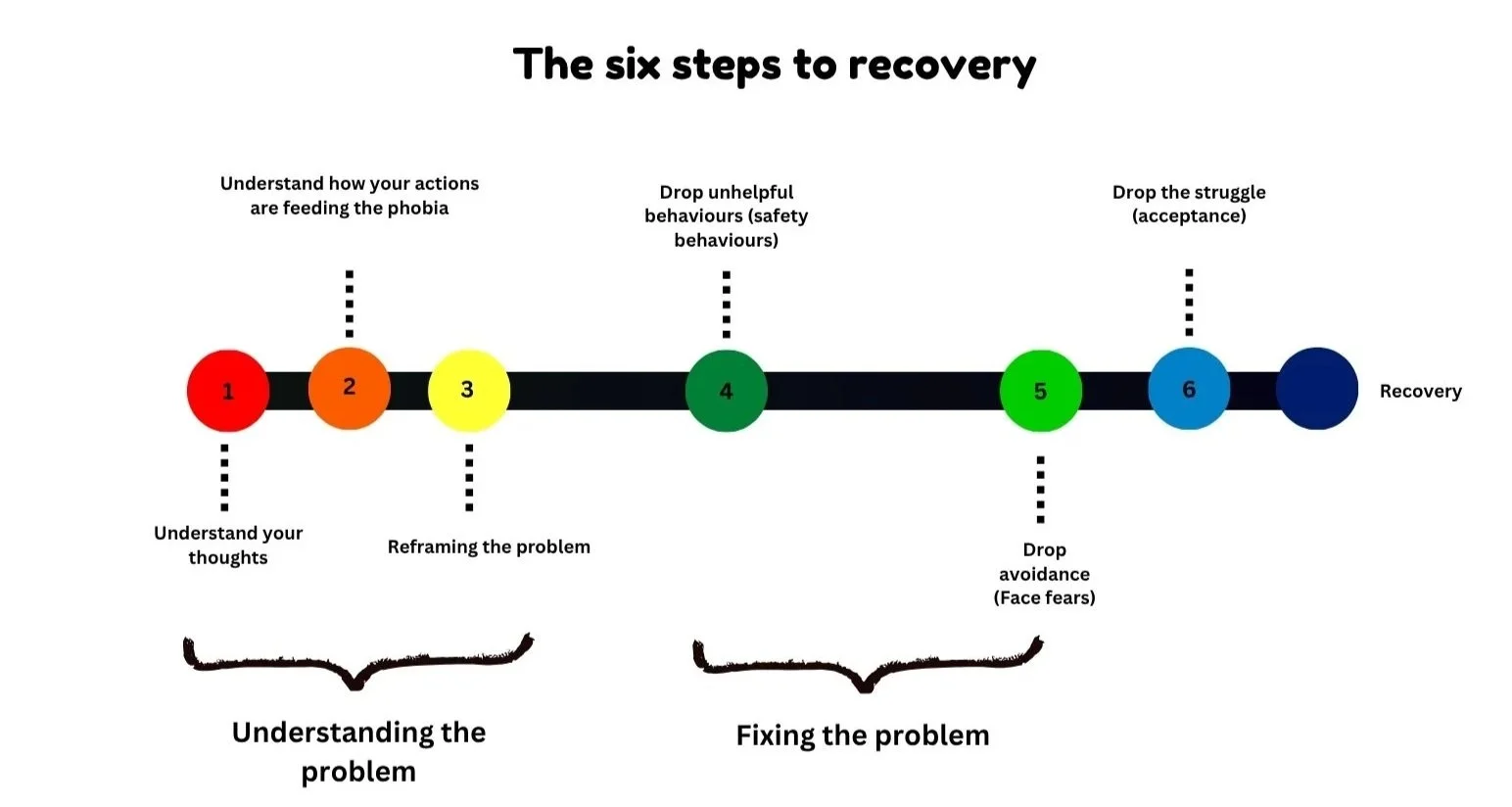
Cognitive Behavioural Therapy (CBT) is the gold standard for Emetophobia. CBT is a generic term for a framework during therapy, so sessions look very different based on which therapist you have. When I work with clients, I focus on a six stage process for recovery.
Stage 1 - Understanding thoughts
The first stage of treating Emetophobia is to first understand what anxiety is and to understand the thought processes that are driving it. Once we understand your thought processes, therapy can move from seeing anxiety as being the problem, to starting to see our thoughts as the driving factor behind anxiety.
Stage 2 - Understanding behaviours
The second stage in treating Emetophobia is to understand the maintenance of the anxiety. This is about understanding how the actions you take to feel safer and less anxious might actually be a big part of the problem.
Stage 3 - Reframing “the problem”
The third stage in treating Emetophobia is to redefine the problem. Those with Emetophobia come into therapy viewing vomiting as the problem. When vomiting is seen as the problem, the only solution is to avoid, prevent or tolerate it. This does not work and only feeds your fear. Stage three is about changing the focus from vomiting and into the fact that Emetophobia is an “interpretation” problem. Those with Emetophobia interpret vomiting as much worse than it is. This allows therapy to progress by changing your interpretation of vomiting, rather than having to avoid vomiting.
Stage 4 - Dropping unhelpful behaviours
The fourth stage in recovering from Emetophobia is to break out of those behaviours which are maintaining anxiety. We need to understand the reason you use each one of these unhelpful behaviours. Once that it is understood it becomes possible to test out how needed (or not) these behaviours are. Once these behaviours are stopped, anxiety and the intrusive thoughts about vomiting massively decrease.
Stage 5 - Dropping avoidance
The fifth stage of overcoming Emetophobia is to start to face your fears. This is often the step many clients worry about. This fear is the reason the internet is full of sites and therapists promising recovery without exposure therapy. Exposure feels hard and people would rather avoid it. But on some level, we all know that facing fears is the best way to build confidence. For example, if you had a friend who feared driving, you would say they needed to drive more and build their confidence.
Exposure therapy for Emetophobia is a little different. No one wants you to face actual vomiting, but you need to face the situations and places you avoid out of fear of it happening. This helps you learn that vomiting is not that likely and that you don’t have to be afraid all the time.
Stage 6 - Dropping the struggle
The sixth stage of recovering from Emetophobia is learning the drop the struggle against anxiety and learn some acceptance. Acceptance is a bit of a misunderstood term and often incorrectly used. In this context, it refers to the fact that the attempts to stop vomiting are often causing more impact on your life than being sick. It is about recognising that it might not be a cost worth paying and that there might be an alternative way.
How to access help for Emetophobia
It is important to consult your GP if your symptoms are severely impacting your nutrition or physical health. There is a lot of support available for Emetophobia. The best treatment currently available is cognitive behavioural therapy (CBT). However not every CBT therapist knows how to treat Emetophobia and it often requires a therapist with specialist knowledge. If you are interested in private therapy with an Emetophobia specialist you can book a free consultation with myself [Free Therapy Consultation — Emetophobia UK].
Click here for more information on how therapy can help [Therapy for Emetophobia (fear of vomiting) — Emetophobia UK].
If you are in the UK, support is often available on the NHS. Click here to find your local NHS provider [NHS Talking therapies service].
FAQs (Frequently Asked Questions)
What triggers Emetophobia?
Day to day triggers vary based on person to person but most often include feeling a sensation in your stomach, seeing the word "vomit," hearing someone else is ill, or being in crowded places where someone might become unwell.
Can it start after one illness?
Yes. For some, a single traumatic experience where they felt out of control or panicked while being sick can be the catalyst for the phobia. Others have had had multiple episodes and some don’t remember having any traumatic episodes of vomiting at all.
Is Emetophobia genetic?
While there isn't a specific gene, you may inherit a predisposition toward anxiety or a sensitive nervous system, which makes developing a phobia more likely. Your genetics only play a part of the puzzle. There is a phrase “your genetics load the gun, your environment pulls the trigger”. But even if you have a genetic predisposition towards anxiety, treatment remains the same.
Can children develop Emetophobia?
Yes, children can develop this fear. Emetophobia often develops in children and young people. This often occurs after a stomach bug or seeing a peer be sick at school. Early intervention with CBT is very effective for younger people.
Why does avoidance make it worse?
Avoidance prevents you from "disconfirming" your fears. Every time you avoid a situation, you tell yourself that the situation was truly dangerous, which increases your anxiety for the next time.
Can CBT help even if I don’t know the cause?
Absolutely. CBT focuses primarily on what is happening now. It is about the thoughts and behaviours keeping you stuck today, rather than just the origin of the problem.
Written by David Kaneria - Emetophobia Specialist
Disclaimer: This article is for informational purposes only and does not constitute medical advice. Please consult a qualified healthcare professional or your GP for personalised support.