

Emetophobia & Exposure Therapy: Why words and images help you recover
Living with emetophobia (the fear of vomiting) often feels like living in a world full of landmines and triggers. You might avoid certain foods, skip social events, or feel a surge of panic at every sign of stomach discomfort. Over time, as your avoidance grows, your world can shrink. For some with emetophobia, their world has shrunk so much that even seeing a specific word in a book, an image on social media or sickness on tv is enough to trigger their anxiety and prompt their desire to avoid.
If you have ever considered treatment for emetophobia, you have most likely come across the idea of "exposure therapy". It most likely sounded terrifying and your first thought was most likely “I can never do this”. You may have heard that you would be asked to look at photos and watch videos of things you would rather avoid. You mostly like had the thought: “How can looking at a word or a photo possibly help me feel safer? It only makes me feel worse!”
The answer lies in how your brain processes threats. By using exposure, we can retrain your nervous system to distinguish between a real and a false danger.
The brain’s false alarm: why "words" feel dangerous
The human brain is a master of association. The way it makes sense of the world by linking things it sees as connected. This is why a smell can easily bring back a forgotten memory from childhood or why a song can remind you of a person you haven’t thought about for years.
For those struggling with emetophobia, they view sickness as the worst thing ever, and so their brain often starts to "tag" anything related to illness as an active survival threat. This can often include words, sounds, smells, or images.
When you see a trigger, a part in your brain designed to recognise threats called the amygdala sounds a full-blown alarm. Your heart races, your breathing quickens, your palms sweat, and your stomach churns and you can start to feel nauseous.
Even though a word on a screen or a cartoon drawing cannot physically make you sick, your body reacts as if it is an immediate danger. Exposure therapy for emetophobia works by proving to your brain, through experience, that these reminders are "false alarms" and are in fact safe.
The three ‘emetophobia loops’:
There are three distinct loops those with emetophobia can get trapped in:
The ‘disgust-nausea loop’
The ‘anxiety-nausea loop’
The ‘anxiety-anxiety loop’
These loops typically cause triggers to feel scary, cause anxiety and produce nausea. Exposure can help break out of all three of these loops which is needed for recovery. Lets explore these loops in more detail:
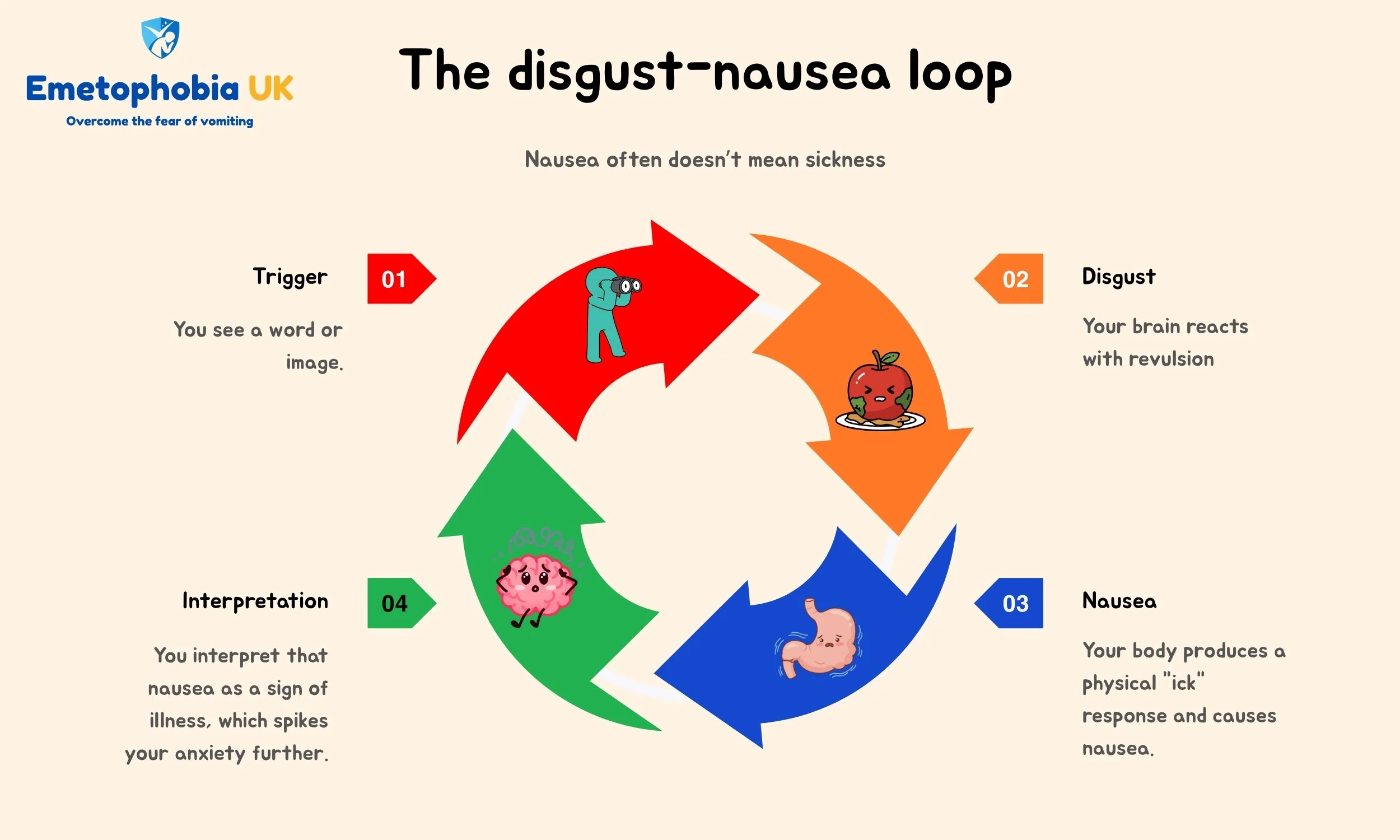
The “disgust-nausea loop”
One of the most challenging parts of this phobia is the disgust response. When you encounter a trigger related to sickness, your brain generates a high level of disgust. This emotion is designed to create the physical sensation of nausea. For an emetophobe, this nausea is terrifying because it feels like the beginning of the very thing you fear to happen. The loop looks something like this:
Trigger: You see a word or image.
Disgust: Your brain reacts with revulsion.
Nausea: Your body produces a physical "ick" response and causes nausea.
Interpretation of sickness: You interpret that nausea as a sign of illness, which spikes your anxiety further.
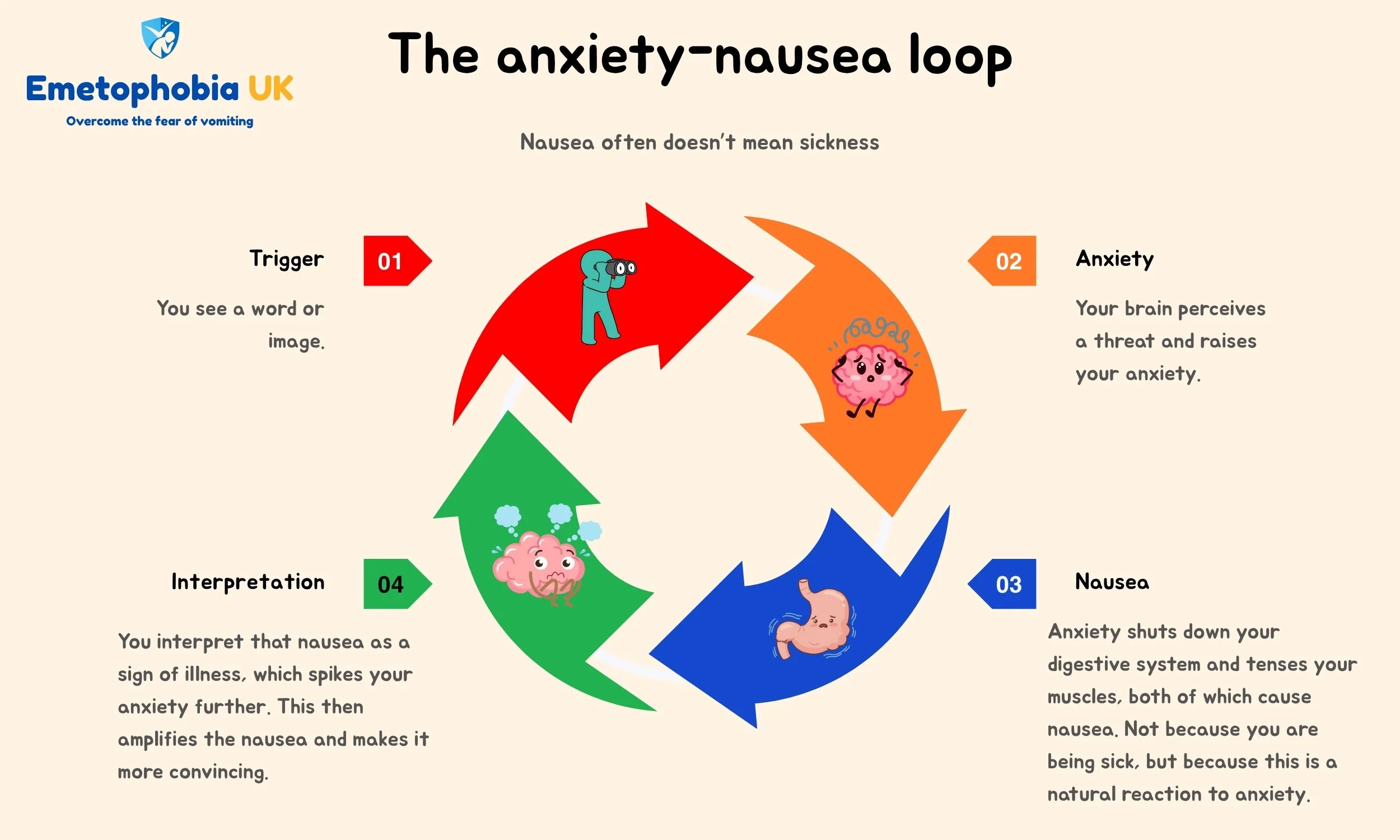
The “anxiety-nausea loop”
Unfortunately, this is not the only nausea loop to exist for those with emetophobia. There is a second loop which also takes place:
Trigger: You see a word or image.
Anxiety: Your brain perceives a threat and raises your anxiety.
Nausea: Anxiety shuts down your digestive symptom and tenses your muscles, both of which cause nausea. Not because you are being sick, but because this is a natural reaction to anxiety.
Anxiety: You interpret that nausea as a sign of illness, which spikes your anxiety further. This then amplifies the nausea and makes it more convincing.
Both these loops cause intense fear and need to be broken to help you recover.
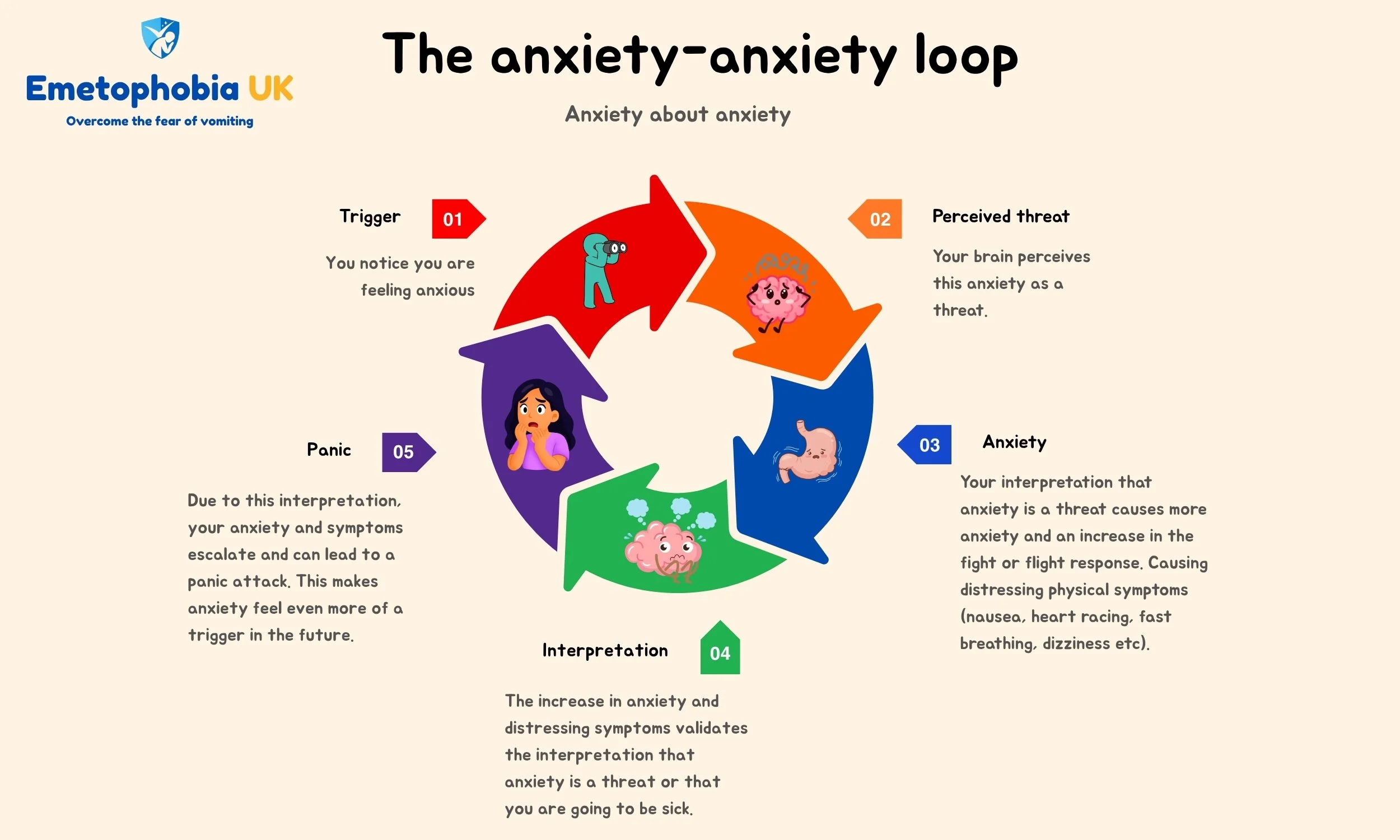
The ‘Anxiety-Anxiety Loop’
Anxiety is designed to look out for threats. However, the ironic thing is that anxiety can start to become afraid of itself. This causes a massive feedback loop.
Trigger: You start to notice that you are feeling anxious.
Perceived threat: Your brain perceives having anxiety as a threat.
Anxiety: This causes more anxiety as your fight or flight system turns on in response to itself.
Interpretation: You interpret this escalation in anxiety sensations as dangerous.
Panic: This increases the symptoms in a feedback loop which can cause a panic attack.
Each time this happens, you learn to hate and fear anxiety even more.
Breaking these loops
These loops can be broken through ERP for emetophobia (Exposure and Response Prevention). ERP is about leaning into these triggers rather than avoiding them to prove they are safe. By repeatedly facing our "disgust and anxiety response" without running away, the brain eventually "un-tags" these triggers with danger. When the loop breaks, the physical nausea and anxiety diminishes because the brain no longer views the thought or image as a threat.
What is exposure and response prevention?
Exposure isn't about jumping into the deep end of the pool on day one. We use something called a "graded hierarchy". This is like a ladder of steps that move from least scary to most scary.
The process typically starts with words and moves on to slightly more challenging things as your confidence grows. It might look like this:
Words: Reading, writing, or saying words related to vomiting.
Images: Looking at black-and-white drawings, then colour photos, then high-resolution images.
Sounds: Listening to audio clips that mimic the sounds of illness.
Videos: Watching brief, then longer, clips of people feeling unwell.
The "Response Prevention" part is key. While doing these exercises, you practice not using safety behaviours. Safety behaviours are any action you try to do in response to these triggers to prevent them from leading to sickness or to reduce your anxiety (like looking away, using anti-emetics, or seeking reassurance). These behaviours trick your brain into seeing these triggers as a threat that needs to be managed. These behaviours are why we often continue to feel scared even in the absence of our fears occurring. This is because these safety behaviours block exposure therapy from working. This is often why people who have tried exposure therapy on their own in the past have not found it helpful. They did not drop their safety behaviours; they only did the “exposure” part of exposure and response prevention.
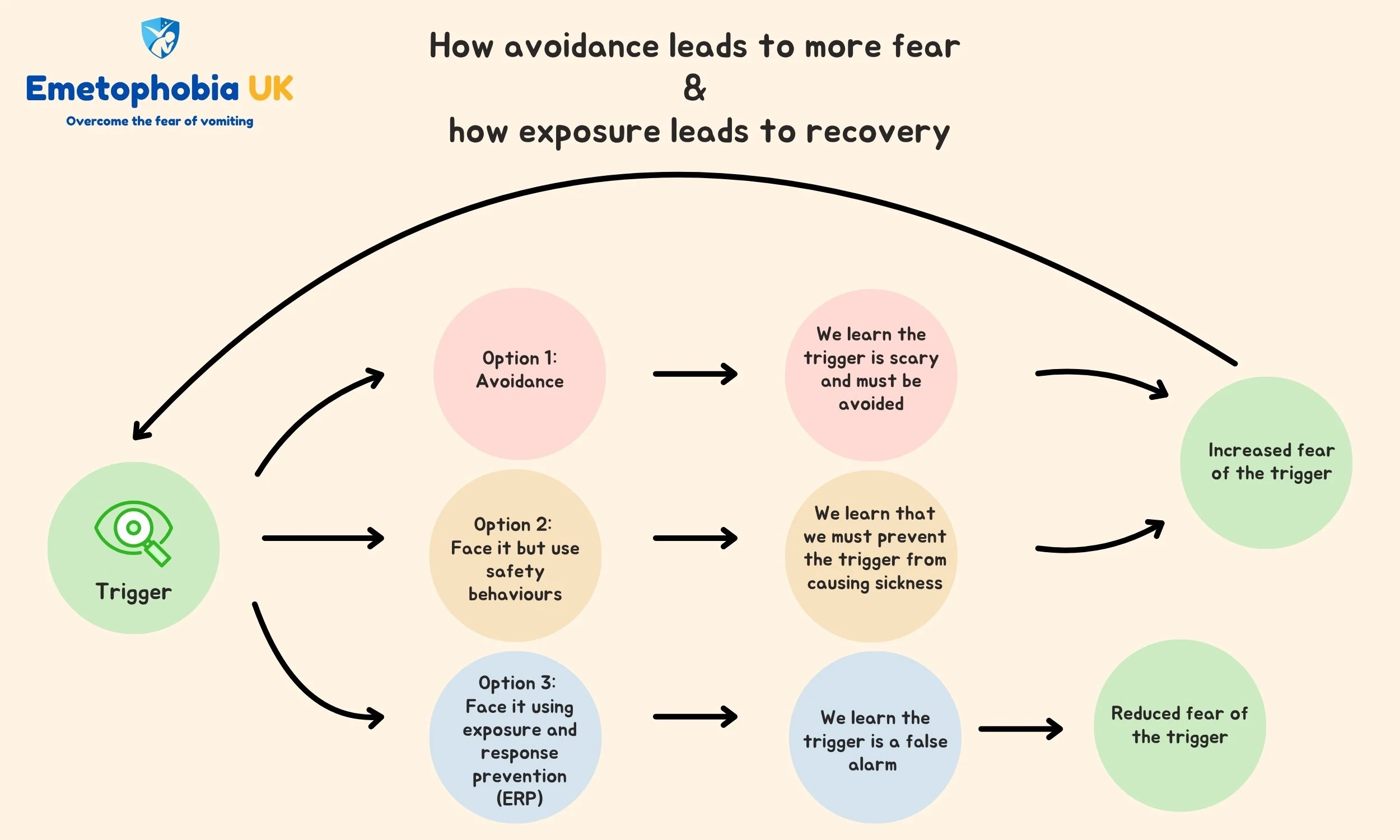
What to expect with ERP: feeling "sick" without being sick
It is important to be honest. Exposure therapy is uncomfortable. When you begin, you will feel a spike in anxiety. You will likely feel nauseous due to the disgust and anxiety loops.
However, it is vital to remember one key thing. This nausea is a symptom of anxiety and disgust, not a sign of illness.
During exposure therapy your brain is sending of a “danger” signal. Seeing this like a fire alarm that is going off when there no fire. It is loud, convincing and hard to ignore…but it is incorrect. Doing exposure is completely safe.
When your brain produces this alarm, and you don’t try and prevent sickness, your brain starts to learn that the trigger didn’t lead to anything bad happening. It starts to learn that the trigger and sickness are not associated. It learns there is so threat.
How to use ERP:
Exposure and response prevent is an easy process:
Trigger: Select a small trigger such as a word, cartoon, photograph, sound or image.
Exposure and response prevention: Allow yourself to look at the image (exposure). Do nothing to try and prevent your fears (response prevention)
Wait: Continue until your anxiety reduces and until you realise you are safe.
Continue and repeat: Once that trigger is safe, repeat the process on another trigger.
Take the First Step Toward Freedom
Emetophobia thrives on avoidance, but your world doesn't have to stay small. By slowly facing these triggers, you can take the power back from your phobia and start living a life defined by your interests, not your fears.
Ready to start your recovery journey?
If you are looking for support with your phobia. You can a few options:
Firstly, you can have therapy with myself. My name is David Kaneria and I specialise in treating emetophobia. I have offer both exposure therapy as well as a ‘low exposure’ alternative for those who are not ready to try exposure therapy. I offer a no commitment, no pressure, free 15-minute call to answer your questions about what therapy can do for you.
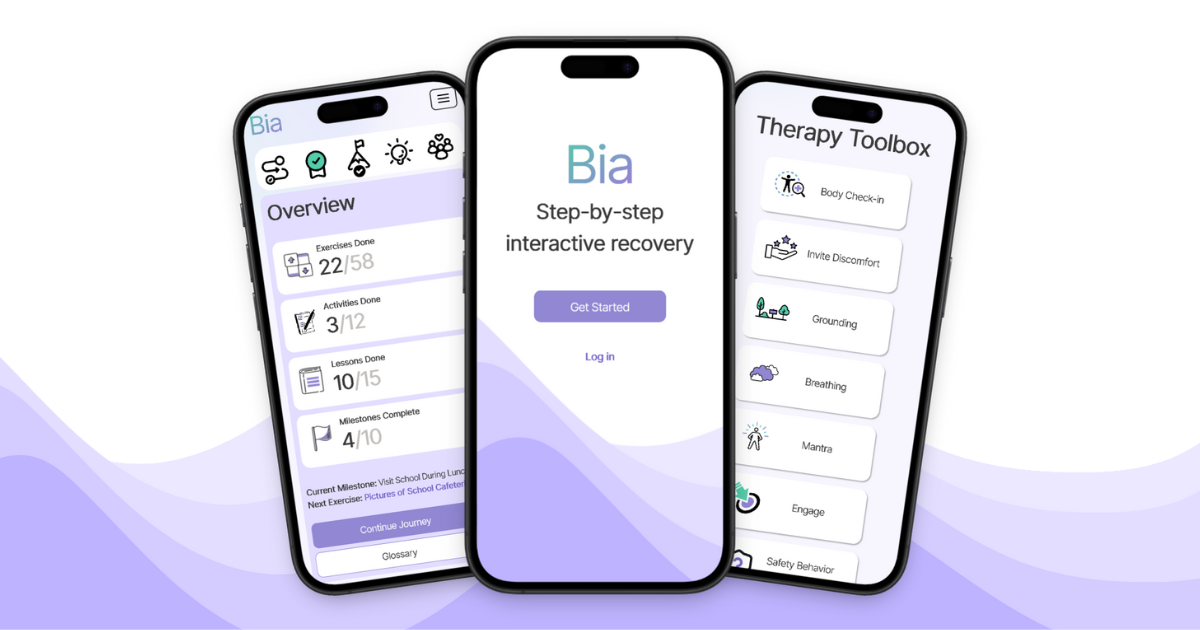
The other option is using the worlds leading emetophobia App balled ‘Bia’, short for pho(bia).
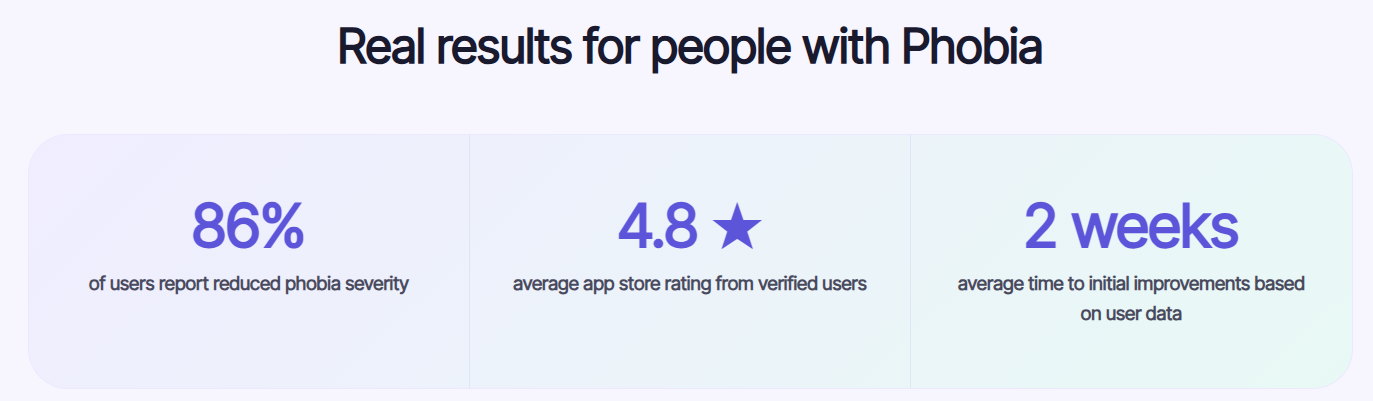
I have recently partnered as a therapy provider with the Bia App. The Bia app is the leading emetophobia app that is dedicated to helping you recover. Founded, designed and run by William Schaller, who himself had Emetophobia for most of his life and who overcame it himself using the principles he built the app around.
The app guides you step by step at overcoming your fears. It tracks your anxiety and automatically adjusts to your speed to ensure you get the maximum benefit without pushing yourself too hard. It prompts you with daily tasks directed towards your own personal recovery.
Click here for more information on the Bia app
The Bia App can be used independently or you can have a therapist like myself guiding you alongside using it. If you want more information on combing therapy and the App you can book in a free consultation with myself.