


Understanding emetophobia and breaking out of the cycle of reassurance seeking
Stop Reassurance Seeking
Learn to face uncertainty and without needing someone or something to tell you that everything will be okay.

From understanding to action
You’ve already learnt why reassurance keeps emetophobia going.
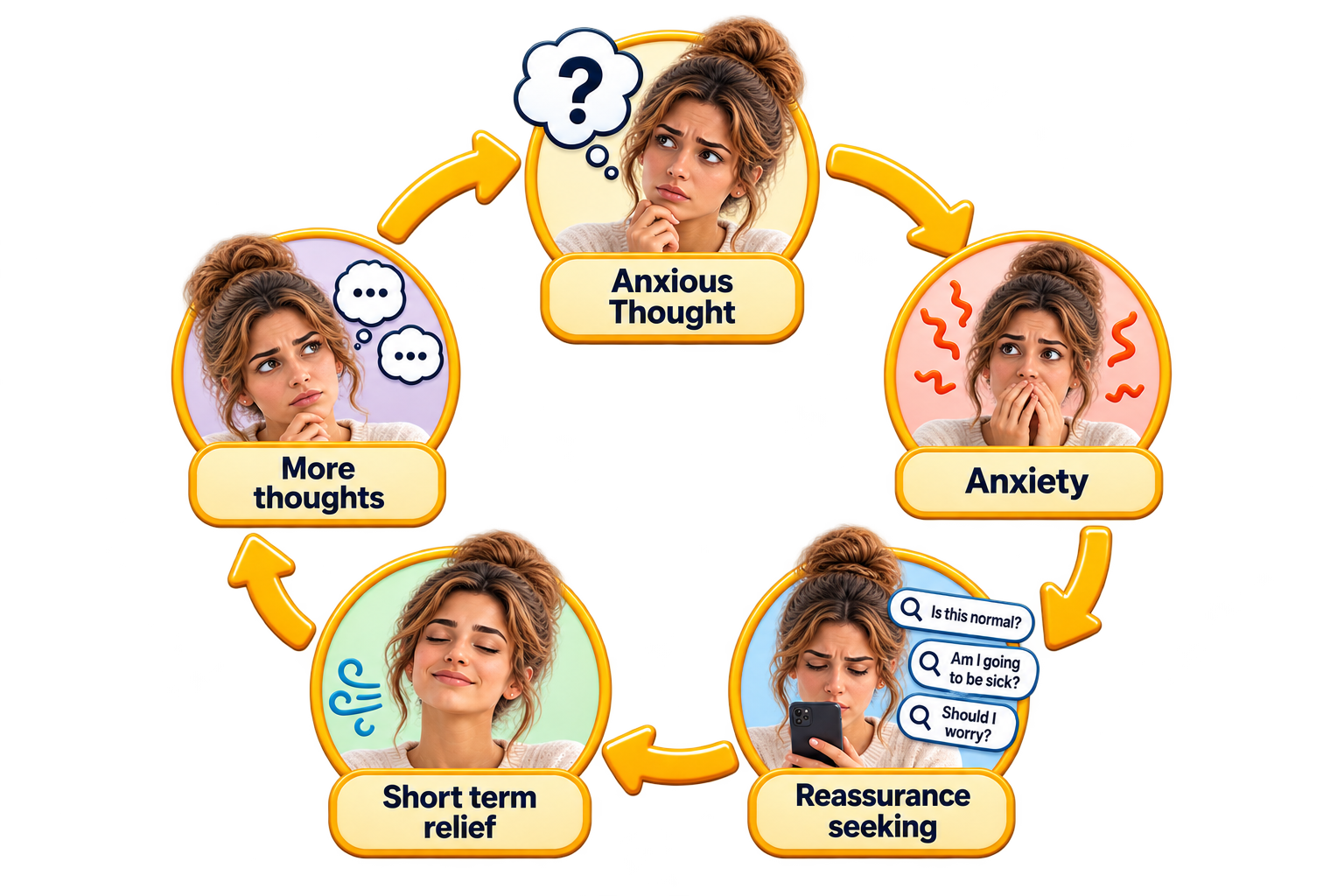
On the previous page, we looked at how reassurance seeking can provide short-term relief while keeping your fear going in the long term.
Reassurance seeking only leads to a cycle which produces more anxious thoughts in the long term and blocks you from learning you are safe.
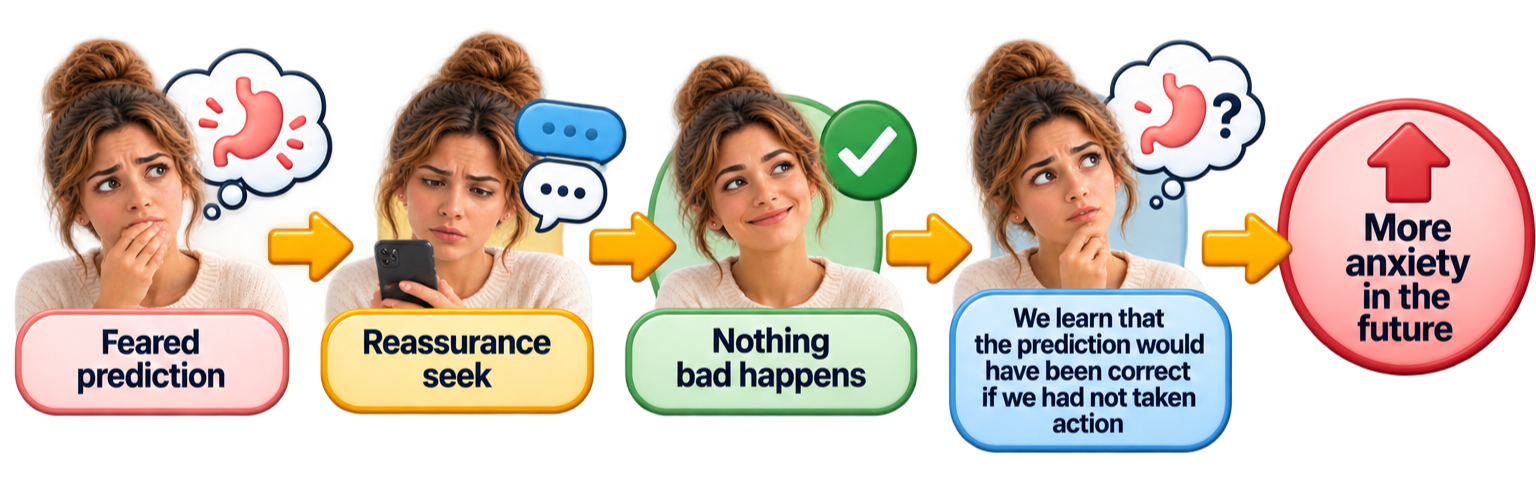

Reassurance seeking is not random, it is fuelled by our belief that it is helpful or necessary.
Reassurance seeking is done because we believe it does 1 or more of these things.
Reassurance seeking reduces the chances of you being sick. Usually because it allows you to spot problems or change how you act.
That you can not tolerate not knowing what will happen or see it as not being responsible.
That you think that reassurance seeking is the answer to managing your anxiety.
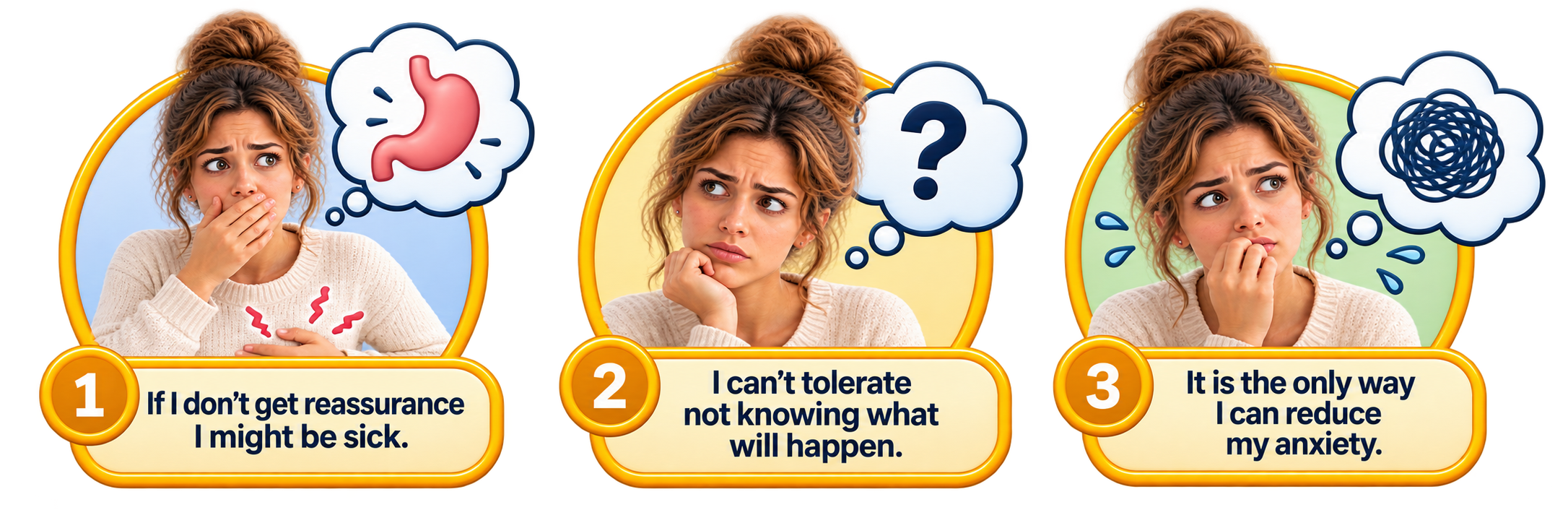
Each of these ideas are false and is a lie your emetophobia has gaslit you in thinking is true.
How to stop reassurance seeking
The best way to reduce your reassurance seeking is to expose these three beleifs as lies. When you no longer see reassurance seeking as helpful, it is much easier to stop doing it.
We can achieve this by testing out these three ideas to prove if they are true or false.
1) If I don’t get reassurance I might vomit.
2) I can’t tolerate not knowing what will happen.
3) It is the only way I can reduce my anxiety.
If these things are not true, then there is no need to reassurance seek.
How do we test an idea
We can test these ideas out by creating something called a behavioural experiment. A behavioural experiment is just when we change out actions and watch the result in order to test out an idea.

Alternating Experiment:
The first thing we are going to do together is test out if reassurance seeking is helpful or not. We can do this by using something called an “alternating experiment”. An alternating experiment is a Cognitive Behavioural Therapy (CBT) technique used to help someone understand the impact of their safety behaviours on their emotions, thoughts and overall well-being. This technique involves comparing two different approaches (A and B) to see which one is more effective.
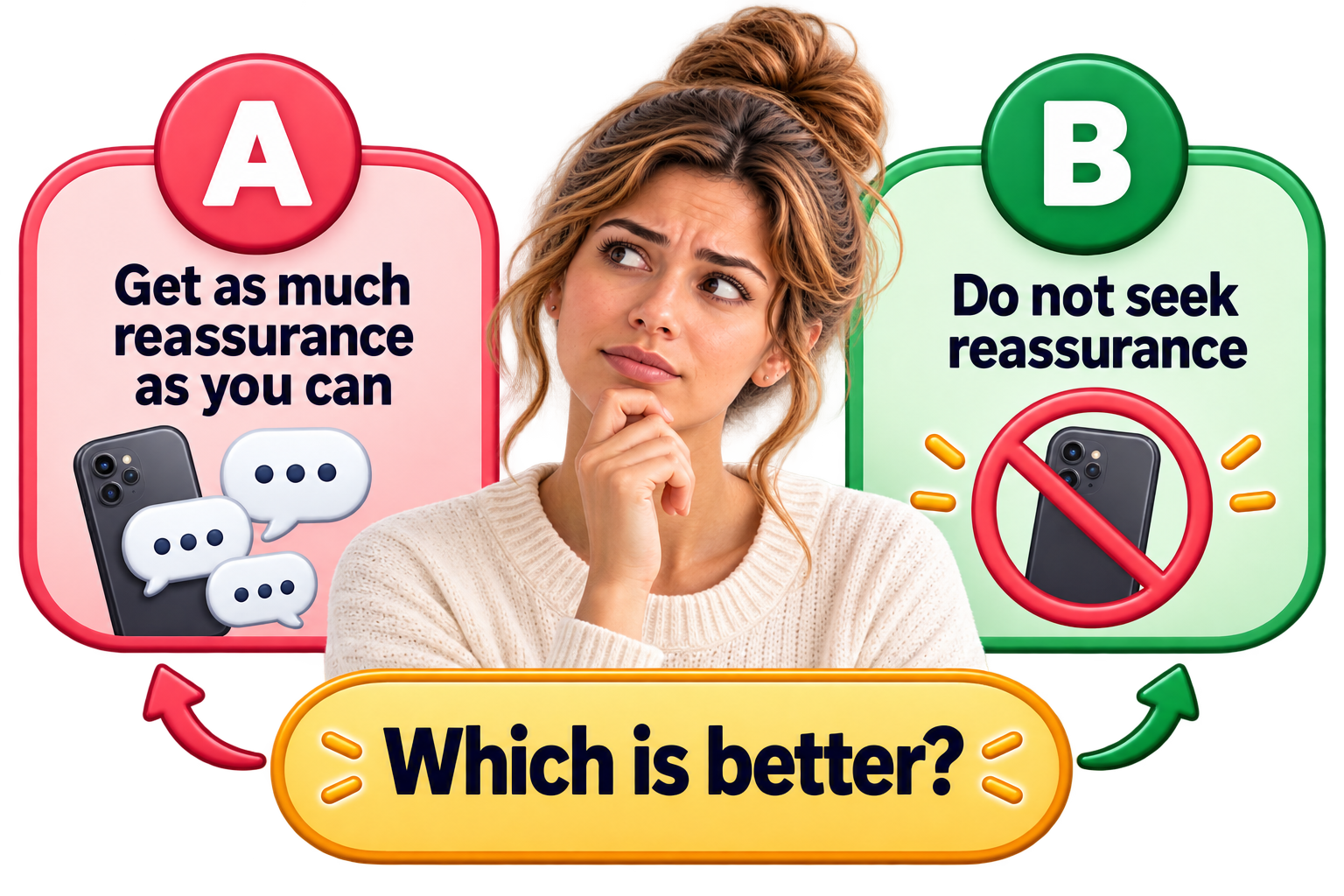
The approach we are going to take is to alternates between days where you try to get as much reassurance as you can (A) and days where you aim to ban the act of reassurance seeking (B). This helps us compare the true effect of reassurance seeking has on yourself.
To help with this I have created a chart you can use to record your progress.

Instructions:
Step 1 - Rate your belief: Look at the three beliefs about reassurance seeking.
1) If I don’t get reassurance I might vomit.
2) I can’t tolerate not knowing what will happen.
3) It is the only way I can reduce my anxiety.
Rate the strength of your belief on a scale from 0 to 100%, with 100% being I believe this totally.
Step 2 - Alternate days: Alternate between days between trying to get as much reassurance as you can and days of resisting reassurance seeking.
- Reassurance days: On days when you are allowed to reassurance seek you must try and do it excessively. Do it even more than normal and even about things you are not even anxious about. The purpose of engaging in excessive reassurance seeking on some days is to test the belief that "if reassurance seeking is helpful, then doing more of it should be even more helpful." By deliberately seeking reassurance excessively, you can observe the impact it has on your anxiety levels, thoughts about vomiting, and overall feelings of nausea. This allows you to gather evidence on whether reassurance seeking truly helps reduce your anxiety or if it might be reinforcing your fears.
- No reassurance days: Resisting reassurance seeking on the designated days is crucial for this experiment to work. Try your hardest to resist any form of reassurance seeking. If you really struggle with this, at least try to delay the reassurance or to reduce it as much as you can. But aim for zero is the best.
For each day rate the effect reassurance has on you:
Anxiety rating (0-10): Rate your general level of anxiety on a scale from 0 to 10.
Doubt/uncertainty (0-10): Rate how much uncertainty or doubt you felt on average for the day on a scale from 0 to 10.
How likely being sick or your problem felt (0-10): Rate how much you felt your feared outcome would happen 0 to 10.
Tips for the Week
- Its okay to feel anxious: You are trying something new, you may feel anxious at first when attempting to not seeking reassurance.
- Stay Consistent: Make sure to follow the alternating pattern of reassurance seeking and resisting it. Consistency is key to getting accurate results.
- Be Honest: Rate your anxiety, nausea, and thoughts about vomiting honestly. This will help you understand the true impact of reassurance seeking.
- Seek Support: If you find it challenging to resist reassurance seeking, consider seeking support from a therapist or a trusted person. They can help you stay on track and provide encouragement.
- Reflect Daily: Take a few minutes each day to reflect on your experiences and fill out the chart. This will help you gain insights into your behaviour and thoughts.
- Compare and Contrast: At the end of the week, compare the days you sought reassurance excessively with the days you resisted it. Look for patterns and differences in your anxiety levels and thoughts.
- Challenge Your Beliefs: Use the experiment to challenge the beliefs that drive your reassurance-seeking behaviour. Ask yourself if the outcomes matched your predictions and what this means for your need to seek reassurance.

Try the experiment for a week before continuing. Book mark the page and come back later!
See you soon!

Experiment Reflection:
Well done on doing your experiment. Now it is time to examine and reflect on the results. The aim is to decide if this safety behaviour is as helpful as you thought it was.
Let’s start by looking at each belief:
1) ‘If I don’t get reassurance I might vomit.’:
One of the main reasons people reassurance seek is to stay safe. So we need to reflect on if anything bad occurred due to not getting reassurance.
So, were you sick this week? Most likely not because being sick a rare and reassurance seeking isn’t often factually needed. So, if you were not sick this week, what does that say about the need to use reassurance to prevent sickness? You stopped seeking reassurance for half the days of the week. Did anything bad happen as a result on the days you stopped reassurance seeking?
Most people who do this experiment are not sick during the experiment. This is because reassurance seeking often have no real impact on the chance of being sick.
What have you learnt about the need to ask for reassurance to prevent sickness? Was it necessary?
2) ‘I can’t tolerate not knowing what will happen.’:
Reassurance seeking is done when we doubt the answers we tell ourselves, and feel the need to get certainty from others. The problem with certainty is that it rarely exists, especially when it comes to emetophobia worries. We can never know for true if our fears will occur or not.
Most people start to notice that they actually have more doubt when they seek reassurance and have less doubt on the days they did not seek reassurance. This is because certainty doesn’t really exist. The more you try to get it, the more you think about the future, and the future is always uncertain. So the more you reassurance seek, the more possibilities you generate about the future, each one with more doubt and uncertainty.
What happened for you? Did reassurance influence this at all. What have you learnt about your ability to handle uncertainty without resorting to reassurance seeking?
Safety:
Safety behaviours are designed to make us feel safe. However, in nearly all cases, this backfires, especially in the long term. When people excessively reassurance seek, they only become pre-occupied with their anxious thoughts and fears. This makes them feel less safe. On the days you got more reassurance, what happened to how at risk of being sick you felt?
Did it make you feel safer, or less safe. Sometimes it can work, but overall, it typically means you end up always feeling unsafe at at risk.
3) ‘It is the only way I can reduce my anxiety.’:
Have a look at your anxiety ratings each day. Everyone’s experiment will be different, but most people start to realise that on the days they excessively reassurance-seeked, they were actually more anxious, not less. This is because to seek-reassurance, you had to engage more with your anxious thoughts for longer and were reacting as if they were based on a realistic and probable threat. Also, the more reassurance seeking you did, the more you were likely to get an answer you don’t like or for you to doubt the answers. Both increase anxiety.
On the days people ban reassurance seeking, people often report feeling less anxious. This is because you disengaged with the thoughts quicker. It also means you were less likely to increase your doubt or hear information that would make you more anxious. However, it is possible you felt a bit more anxious at first due to trying something new. Maybe try the experiment for longer to see if you get more used to it.
What have you learnt about how true this belief is?
Where you unmanageably anxious, or did you find a way to tolerate, cope or better yet accept feeling anxious?
Did reassurance make you feel better or worse? What about in the long term?
Experiment Conclusion:
Hopefully have learnt that even though reassurance-seeking may sometimes feel helpful in the moment, it actually often backfires and:
-It makes you feel more anxious.
-It causes you to have more thoughts about vomiting
And most importantly, in 99.99% of cases, the lack of reassurance seeking did not lead to vomiting.
If this is the case. Try to reduce reassurance seeking going forward.
So what is better:
A: Getting as much reassurance as you can.
B: Not seeking reassurance.
Now what?
If you are not 100% convinced that reassurance seeking is not needed, try the experiment for longer, or try proving it by making yourself a custom experiment.
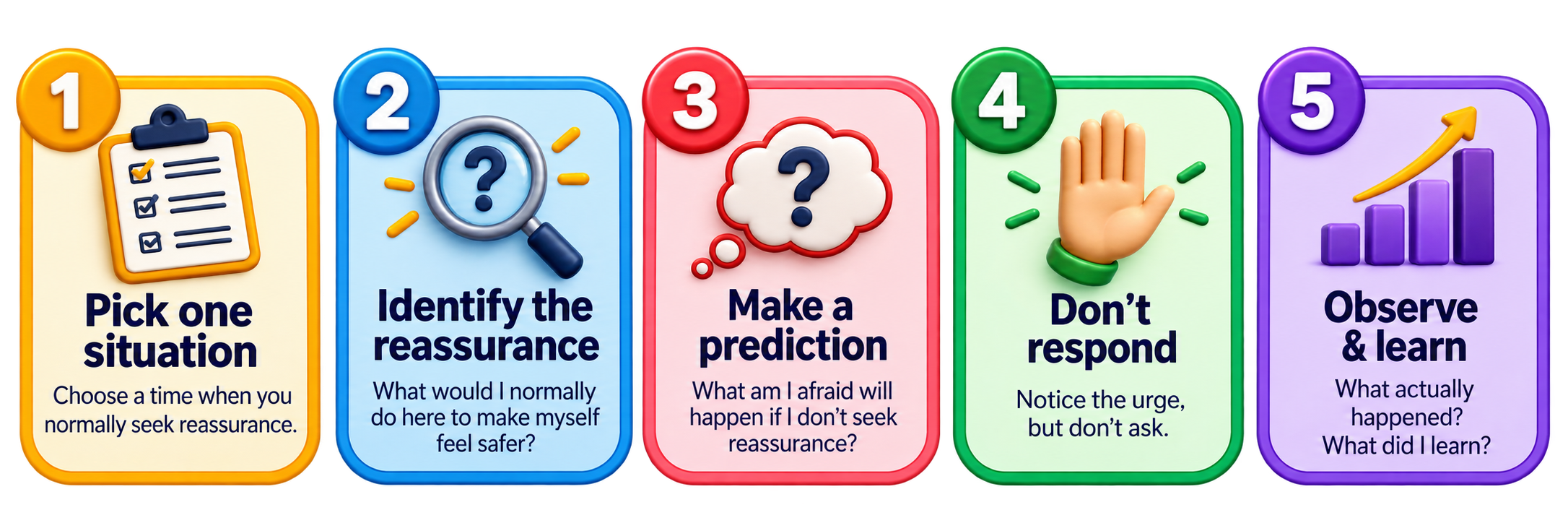
The idea that reassurance seeking is helpful is easily testable. You can face a situation on purpose that you usually attempt to get reassurance about and resist that urge. Watch the results and see what happens.
For example:
Imagine someone who fears getting food poisoning and so usually asks for reassurance from their husband to make sure the dinner has been cooked properly. On some level they think this is helpful because it ensures their husband cooks dinner properly and prevents them from vomiting. To test this out they can design a simple experiment where they decide to eat dinner tonight without asking their partner any questions. After the dinner, they will know their answer. Did they get food poisoning or not? And with that outcome they can learn if they needed to get reassurance or not.
Designing and recording the experiment:
We need facts to stand up to our Emetophobia. So we need to design these experiments carefully to make the most of it. Click on the chart to download an editable PDF file to help you create the best experiment possible.
1) Firstly, you need to consider what is rationale behind your need for reassurance. This are often the idea that:
1) If I don’t get reassurance I might vomit.
2) I can’t tolerate not knowing what will happen.
3) It is the only way I can reduce my anxiety.
But feel free to add any other reasons to this.
2) Next you need to consider a way to test this out. Pick a situation that you normally get reassurance about and design an experiment to test the idea that you need to get reassurance (e.g. facing that situation without getting any reassurance).
3) Next you should add something called a feared prediction. This is what the anxiety is trying to convince you will go wrong without this reassurance. This overlaps highly with the first column but is more specific to the exact situation being tested.
Now do your experiment!
After the experiment:
4) Following the experiment, write down what factually occurred.
It is okay to feel anxious as you are trying something new. But focus on how well you coped through this feeling and most importantly reflect on if your fear actually occurred or not.
Reflect on what you have learnt from this. If your fear did not come true, what does that say about the need to get reassurance.
In the unlikely situation where your fear did occur. Focus on what you have learnt abut your ability to cope. And ask yourself, would the act of getting reassurance actually have changed the outcome?
Feel free to repeat the experiment a few times or to create different ones.

Recovery is not about knowing that you won’t ever be sick, it is about learning to live without needing to know.

If you are still not ready, you might benefit from 1:1 support.
Therapy from someone who truly understands emetophobia
Finding a therapist who understands emetophobia can be surprising difficult.
I’m David Kaneria, a BABCP accredited CBT therapist who specialises exclusively in treating emetophobia.
I’ve dedicated my career to learning about this condition, treating people with emetophobia and helping other therapist understand how to treat it effectively.
I’ve also written a textbook specifically about treating emetophobia.
David Kaneria
BABCP Accredited CBT therapist & Emetophobia specialist.